The Secret Social Lives of Indoor Cats (And How to Stop Boredom Meltdowns)
I used to think my cat was “low-maintenance.” She slept all day, casually bullied her toys at 2 a.m., and stared out the window like she was binging outdoor Netflix. Then she started randomly attacking my ankles, screaming at 5 a.m., and chewing through three charging cables in a week. That’s when I realized: this wasn’t “quirky.” She was bored out of her tiny feline mind.
When I started treating her like a complex, social predator instead of a furry roommate, everything changed. Less chaos. Fewer “crime scenes.” Way more purrs. If your indoor cat is “acting out,” there’s a good chance they’re not bad — they’re under-stimulated.
Let’s get into what’s really going on inside your indoor cat’s brain and how to turn boredom and mischief into calm, confident, happy-cat energy.
Your Indoor Cat Still Thinks It’s a Tiny Tiger
When I first learned that domestic cats share about 95–96% of their DNA with tigers, suddenly my shredded couch made more sense.
Indoor cats look cozy and domesticated, but behaviorally they’re still wired like solo hunters. In the wild, a cat’s day revolves around a cycle behaviorists often call hunt–catch–kill–eat–groom–sleep. Indoors, that becomes… snack–nap–stare at the wall–scream for attention.
Here’s what’s happening under the fur, in plain language:
- Predatory drive: Cats are “obligate carnivores,” built for hunting, not grazing. Their brains are primed for short, intense bursts of stalking and pouncing.
- Crepuscular schedule: They’re naturally most active at dawn and dusk. That’s why the 5 a.m. zoomies feel like your cat is possessed.
- Territorial mapping: Even in a one-bedroom apartment, your cat mentally divides the place into zones: safe spots, ambush zones, high vantage points, resource areas.
- Solitary-but-social: Most cats aren’t pack animals like dogs, but they’re not antisocial either. They form loose social groups, especially around food and safe resting places.
When all of that instinct gets bottled up indoors with nothing interesting to do, it leaks out as:
- Random aggression
- Night zoomies
- Over-grooming
- Meowing marathons
- Door-darting escape attempts
- Chewing or scratching everything they’re “not supposed” to
In my experience, once you respect the tiny tiger and build daily life around that hunt–play–rest cycle, most “behavior problems” get way easier to manage.
Signs Your Cat Is Bored (That Don’t Look Like Boredom at First)
When I tested new enrichment ideas with my own cat, I started by just watching her for a few days without trying to “fix” anything. The patterns were painfully obvious once I paid attention.
Here are some behavior clusters I see a lot when I talk to other cat owners:
1. The Drama MeowerThis cat yells constantly, especially when you’re on a call, in the bathroom, or clearly busy. You feed them. You pet them. They still yell.
What’s often happening: They’ve learned the only time something interesting happens is when you’re active. So they try to create activity.
2. The Nighttime MenaceFine all day. A literal parkour athlete at night. Pounding across the bed, knocking stuff off shelves, attacking your feet under the covers.
What’s often happening: No structured outlet for hunting behavior during the day, so the natural dusk/dawn instinct explodes.
3. The “Bad” Scratcher/ChewerThey ignore the scratching post you bought “for them” and go straight for the couch, the door frame, or your laptop cable.
What’s often happening: Wrong texture, wrong height, wrong location — and zero alternative challenges. Destruction becomes enrichment.
4. The Silent, Still CatThis one is tricky. They sleep all the time, rarely play, barely interact, and people say, “He’s just calm.”
What’s often happening: Sometimes that’s just personality. But it can also be under-stimulation, stress, or even depression, especially if it’s a change from their old behavior. My cat went through this after I moved apartments — it looked like “chill,” but the vet and I both suspected stress.
If your cat’s behavior has shifted suddenly or dramatically, I always recommend a vet check first. Pain or illness can look exactly like boredom or “bad mood.”
How I Turned My Apartment Into a Cat Playground (Without Destroying the Aesthetic)
When I first tried “enriching” my cat’s environment, I went overboard and my living room looked like a daycare center for gremlins. Over time, I figured out what actually works and what’s just expensive clutter.
Here’s how I now think about setting up a cat-friendly home in a way that still feels adult and livable.
Vertical territory: Your cat wants the high ground
One study in the Journal of Feline Medicine and Surgery found that cats with greater access to vertical spaces showed more confident, exploratory behavior and fewer stress signals. I 100% saw this with my own cat.
What helped most for us:
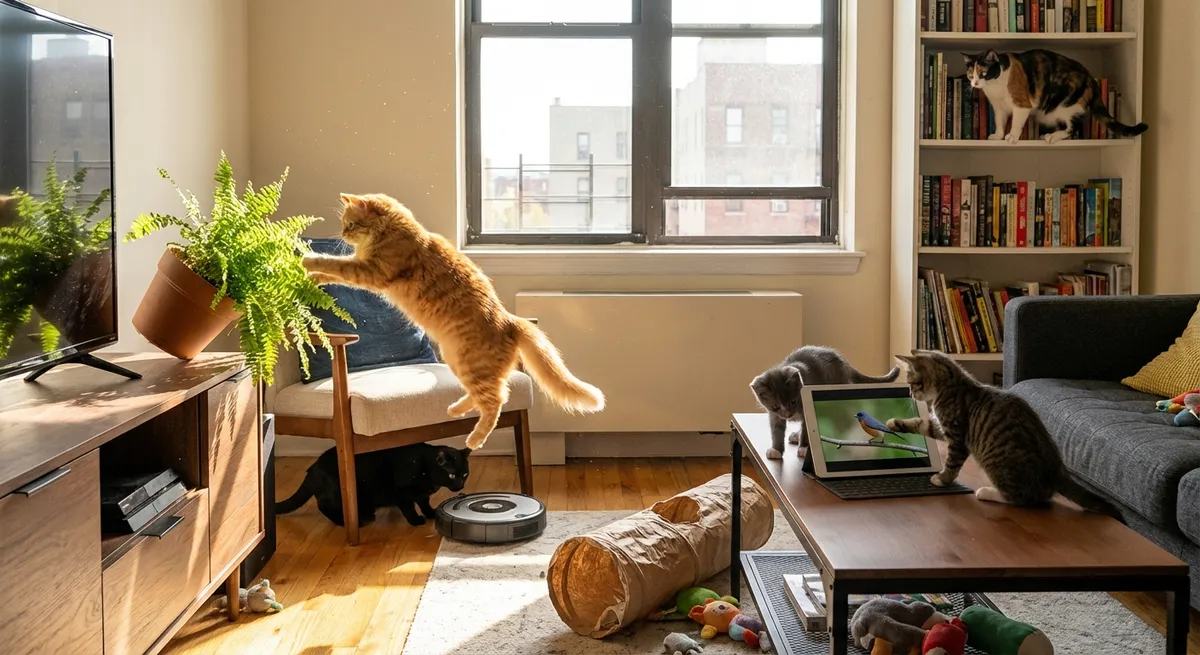
- Bookshelf perches: I cleared a couple of upper shelves and added non-slip mats. Instant “tree.”
- Window shelf: I installed a clamp-on window perch where she can sunbathe and spy on birds. Her mood improved in, like, two days.
- Layered height: Bar stool + chair + shelf, creating a climbable “path” so she can move up and down without a dramatic leap.
If you’ve got multiple cats, verticality also lets them avoid each other when they’re not in the mood to socialize, which can seriously reduce spats.
Scratch stations: It’s not misbehavior, it’s maintenance
Scratching is nail care + territory marking + stress relief.
What worked when I tested different options:
- Tall posts only: Anything shorter than full stretch was ignored. A sturdy, 32+ inch sisal post got daily use.
- Horizontal + vertical: My cat likes to scratch the rug angle-style, so a flat cardboard scratcher in front of the couch arm stopped her from murdering the actual couch.
- Location matters: The scratch post by the front door gets way more use than the one in a random corner. Cats often scratch near entry/exit points and popular hangout zones.
I had to accept this: if the “wrong” object is more accessible, more stable, or more fun to shred, the cat will pick it every time.
Turning Mealtime Into a Hunt (Instead of a Boring Free Buffet)
One of the biggest shifts I made was treating food as a daily mental workout, not just calories in a bowl.
When I tested puzzle feeders with my own cat, she went from inhaling food in 30 seconds to spending 10–15 minutes engaged, focused, and pleasantly tired after. It was like flipping a switch on her chaos levels.
Here are approaches that actually worked:
Slow feeders and food puzzles
I started simple:
- Muffin tin hack: Kibble scattered in a muffin tin, with a few wells covered by ping-pong balls. She had to bat the balls aside to get the food.
- Commercial puzzle feeders: We tried a rolling ball dispenser and a “maze bowl.” The maze bowl slowed her down; the ball turned feeding into a chase game.
For beginners, I learned to keep difficulty low at first. If it’s too hard, some cats just give up and walk away, which you obviously don’t want.
Scatter feeding and “prey trails”
On days when I have more time, I’ll hide small portions of her food around the room — behind chair legs, on a low shelf, under a paper bag.
Benefits I noticed:
- She explored more of the apartment.
- Post-meal napping became deeper and longer (less random chaos).
- She annoyed me way less at my desk because her brain was busy “searching.”
Veterinary behaviorists often recommend this kind of “foraging” as a super-accessible form of enrichment, especially for indoor cats that can’t safely go outside.
“I Don’t Have Time for This” Enrichment: What Actually Works in 10 Minutes
When I’m exhausted, guilty enrichment rarely happens. So I figured out a realistic routine: two structured play sessions a day, 10–15 minutes each, plus some easy “passive” enrichment.
The 10-minute hunt session
Here’s what I do most evenings:
- Use a wand toy (feather, ribbon, little bug) and move it like prey, not like a broken Roomba. That means:
- Slow, stalking motions
- Hiding behind furniture edges
- Occasional “frozen” moments
- Let her chase, stalk, and pounce 5–10 times.
- Let her “win” at the end (catch the toy), then give a few pieces of food or a treat. That completes the “kill–eat” part of her instinctual cycle.
- Follow with a quick groom session if she’s in the mood, then she usually puts herself to bed.
When I skip this for a couple of days, the difference is obvious. More restless pacing, more attention-seeking, more 4 a.m. nonsense.
Passive enrichment for busy days
When I know I’ll be slammed:
- I freeze wet food in silicone molds and let her work on the cat-safe popsicles.
- I set up a bird-feeder outside the window (on the outside, crucial detail) so she has “live TV” to watch.
- I turn on “cat TV” videos on YouTube — birds, fish, small critters. Not all cats care, but mine watches like it’s reality TV.
Do these replace interactive play? No. But they absolutely take the edge off on hectic days.
Do Indoor Cats Need Outdoor Time? The Honest Pros and Cons
Whenever I share that my cat is indoor-only, someone brings up how “sad” that must be. I get it. Watching her stare longingly at the trees does sting a little. So I dug hard into both sides and experimented with some options.
Pros of staying indoors
Based on data from the AVMA and other veterinary sources:
- Dramatically lower risk of traffic accidents
- Reduced exposure to infectious diseases like FeLV and FIV
- Less risk of predator attacks, fights, or getting lost
- Longer average lifespan for indoor-only cats compared with free-roaming
From my experience, indoor-only cats can be incredibly fulfilled — if you put effort into enrichment.
Controlled outdoor experiences
I tried two approaches:
- Harness and leash
- At first she flopped over like I’d removed her bones.
- After a few weeks of very short, treat-heavy sessions indoors, we graduated to the hallway, then the yard.
- Outside, she mostly sniffs, watches bugs, and eats grass like it’s gourmet salad.
- Downsides: It’s weather-dependent. And you have to be 100% present — no scrolling your phone while your cat is in predator mode.
- Cat stroller
- This sounds ridiculous until you try it.
- Bonus for skittish cats who get overwhelmed by direct exposure.
- My cat will sit and quietly watch everything roll by, which seems to scratch that exploration itch.
I decided against unsupervised outdoor time because of local traffic and coyotes. But “safe outdoor experiences” gave her a ton of sensory input without the life-threatening danger.
Multi-Cat Drama: Social Lives, Politics, and Peace Treaties
For a while, I fostered a second cat. That’s when I got a front-row seat to indoor cat politics.
When cats share a space, there are a few key areas where friction explodes:
- Resources: Not just food, but litter boxes, resting spots, scratch posts, and high perches.
- Social preferences: Some cats genuinely like company; others want a roommate in theory but not in practice.
- Introductions: Throwing two cats together and “letting them work it out” can create long-term grudges.
What worked best for harmony:
- Slow scent-based introductions: Scent swapping, feeding on opposite sides of the door, then very short supervised hangouts.
- Resource duplication: The “one litter box per cat plus one” rule turned out to be absolutely real. Once I added boxes and extra water bowls in separate spots, tension dropped.
- Escape routes: Every common area had at least two exit options, so no one could get cornered.
When multi-cat households work, they really work — I’ve seen cats groom each other, play-wrestle, and nap in a cuddle puddle. But forcing socialization on a truly solitary cat often backfires. In my experience, respecting individual personality is more important than the idea that “cats need another cat.”
When to Call a Vet or Behaviorist (Not Just Google It Again)
As much as I love experimenting with toys and DIY puzzles, there are limits to what enrichment can fix.
These are times I’d stop guessing and call a vet or a certified behavior professional:
- Sudden change in litter box habits
- New aggression, especially biting or attacking out of nowhere
- Over-grooming to the point of bald spots or skin damage
- Big drops in appetite, energy, or interest in play
- Loud, distressed vocalization that doesn’t respond to normal soothing
One veterinarian I spoke with compared behavior changes to “the cat sending up a flare.” Sometimes it’s emotional. Sometimes it’s pain. Either way, it’s worth taking seriously.
I’ve had a vet find an underlying dental issue that was making my cat cranky and withdrawn. Once her mouth was treated, she bounced back to playful and snuggly. No amount of new toys would’ve fixed that.
The Big Shift: From “Pet” to Tiny Roommate With Needs
When I stopped thinking of my cat as a decoration that occasionally meows — and more like a very small, opinionated roommate with a hunter’s brain — everything got easier:
- I stopped taking her “misbehavior” personally.
- She got predictable outlets for her energy and instincts.
- The house got quieter, cleaner, and less… shredded.
If your cat is climbing your curtains, terrorizing your ankles, or sleeping 22 hours a day, they’re not broken. They’re telling you how they feel, with the only language they’ve got.
A little creativity, a few minutes of focused play, and a home that’s designed with both humans and felines in mind can turn your “chaotic goblin” into a calmer, more confident little tiger — without sacrificing your sanity or your furniture.
Sources
- American Veterinary Medical Association – Pet Statistics – Data on pet ownership, indoor vs. outdoor risks, and general health trends in cats
- Cornell University College of Veterinary Medicine – Indoor Cats, Outdoor Cats – Detailed discussion of safety, enrichment, and quality-of-life considerations for indoor cats
- International Cat Care – Environmental Needs of Cats – Comprehensive guidance on feline environmental enrichment, territory, and stress reduction
- American Association of Feline Practitioners – Feline Environmental Needs Guidelines (J Feline Med Surg) – Evidence-based recommendations on enrichment, social environment, and stress for indoor cats
- Ohio State University Veterinary Medical Center – Indoor Pet Initiative: Cats – Practical, research-backed tools for creating a behaviorally healthy indoor life for cats