My Dog Thinks I’m Home 24/7 Now — The Weird Magic of “Scent Parenting”
I recently discovered my dog was living a double life. By day, she looked like a normal, mildly spoiled suburban gremlin. By night (aka when I left for work), she apparently turned into a pacing, whining, door-guarding anxiety tornado. I only found this out because I set up a cheap pet camera “just to check.”
What I saw made my stomach drop: she’d walk to the door, lie down, get up, whine, circle, repeat. For hours. I thought I had a chill, well-adjusted dog. Nope. I had a Stage 5 Velcro dog with separation anxiety.
That’s how I stumbled into something trainers casually call “scent work for emotions” or what I now call scent parenting — using your smell, plus your dog’s supernose, to hack their stress levels and help them feel like you’re still “there” even when you’re absolutely not.
And honestly? It’s been weirder, cooler, and more effective than I expected.
The Day I Realized My Dog Lives in Smell, Not Screens
Here’s the trap I’d fallen into: I’m a human with human brain logic, so I kept trying human solutions.
I tried leaving the TV on like some low-budget dog Netflix.
I tried playing “calming music for dogs” on YouTube.
I tried talking to her through the camera (horrible idea, 0/10, she panicked).
Nothing worked. She didn’t want screens. She wanted me.
When I finally sat down with a certified behavior professional, she said something that permanently rewired my brain:
> “Your dog doesn’t live in a visual world the way you do. Her main sense is smell. Right now you’re throwing Wi‑Fi at a nose problem.”
According to research from the AKC and veterinary behaviorists, dogs have up to 220 million scent receptors in their noses (we have around 5 million), and the part of their brain devoted to processing smell is about 40 times larger than ours, proportionally. They basically experience the world as one giant, shifting scent story.
So when you vanish, your smell fades from the house. To a dog, that’s not just “oh, my person left.” It can feel more like “the universe just changed channels.”
Once I understood that, the whole “scent parenting” idea started to click.
How I Turned My Laundry Pile Into an Emotional Support System
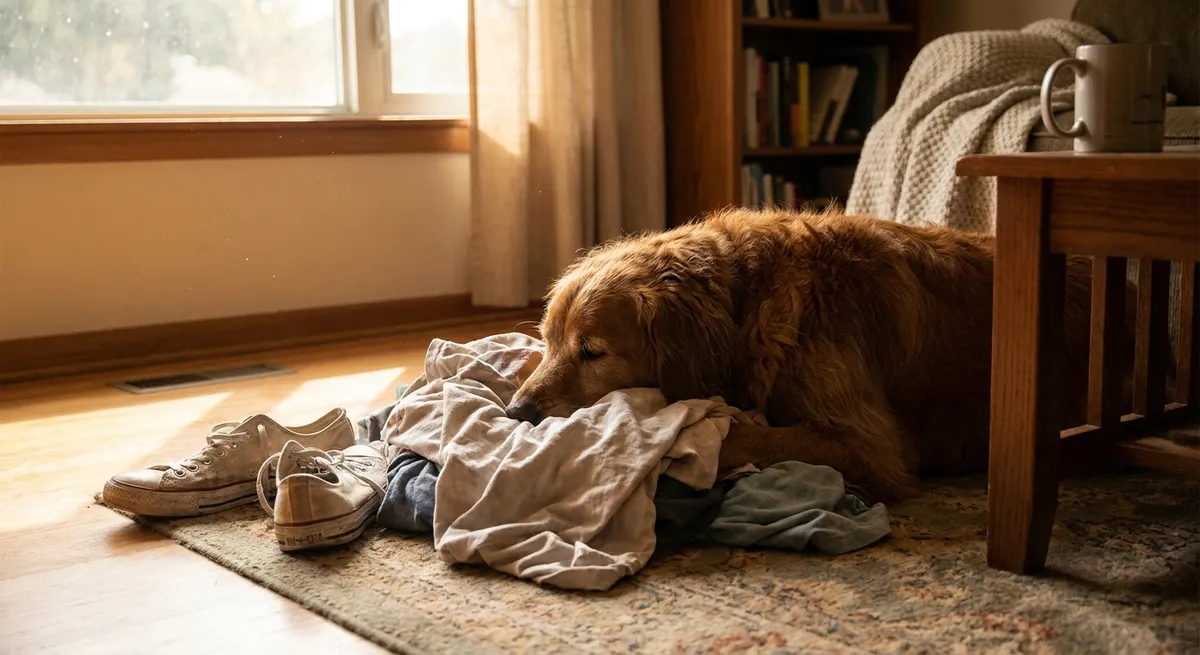
I wish I could say I stumbled onto some fancy high-tech solution, but honestly, it started with my dirty gym shirt.
My trainer suggested this:
“Wear a T‑shirt for a full day. Don’t wash it. Leave it in your dog’s main rest place whenever you go out. Same shirt for at least a week.”
I felt ridiculous. My dog looked delighted.
When I tested this “scent anchor” idea, I did a mini experiment. For three days, I left for work without a scent item. I watched the camera recordings at night. Same pattern: pacing, door-checking, whining spikes around the first hour.
Then for the next three days, I started my new weird ritual: I’d put my worn T‑shirt in her bed, say the exact same phrase every time (“Guard my shirt, I’ll be back”), drop a small treat, and leave.
The difference didn’t show up instantly, but by day three, the camera told a different story. She still walked to the door. But she settled faster. The pacing shrank from 40 minutes to around 10. There was more sleeping, less dramatic sighing at the door like a Victorian widow.
Was my dog cured? No. But the trajectory changed.
The trainer explained why this silliness actually works:
- The shirt acts as a scent constant in a changing environment. Your smell doesn’t walk out with you completely.
- The repeated phrase + shirt + treat builds a predictable “you leave, good thing happens, calm thing happens” pattern in your dog’s head.
- Because smell hits the limbic system (the emotional brain) so directly, your scent can work like an emotional “blanket” while you’re gone.
This is where scent parenting starts: not with gadgets, but with your own smell acting like a long-distance hug.
The Three Kinds Of Scent My Dog Now “Uses” When I’m Gone
After a few weeks of playing amateur neuroscientist with my dog, I realized I was accidentally using three different scent categories:
- My baseline scent – clothes, pillowcases, blanket corners
- Calm-time scents – things I associate with relaxation
- Adventure scents – smells that signal “fun is coming”
Here’s how I use each one (and where it backfired on me).
1. Baseline Scent: The “I Still Exist” Starter Pack
In my experience, baseline scent is the easiest and most powerful. For my dog, that’s:
- A T‑shirt I wore for a full lazy Sunday
- A small pillowcase from my side of the bed
- One old hoodie that’s basically 90% dog hair and 10% fabric
I rotate two or three of these items and keep them in a restricted zone — her crate or designated chill area — only when I leave. The exclusivity makes it special.
When I got cocky and left my hoodie out 24/7, she stopped caring. It went from “this smells like magic safety” to “yeah, that’s just the couch costume you always wear.”
What worked best:
- Not washing the items too often (once a week-ish, unless they’re truly gross).
- Putting them low, close to her usual sleep spot, not on a shelf or table.
- Pairing the scent with a calm, boring exit — no big “BYE BABY I LOVE YOU” scenes. Just shirt down, treat, phrase, door.
2. Calm-Time Scent: Turning Smell Into a Chill Playlist
Once the baseline stuff started working, I layered in what I call “calm-time scents.”
I’m personally sensitive to smells, so I was careful here. A lot of “pet calming sprays” are just overpowering perfumes. Some are fine; others are like spraying anxiety directly onto your dog’s nose.
What eventually worked for us:
- Adaptil diffuser (a synthetic dog-appeasing pheromone backed by several studies) in the room she rests in.
- A tiny bit of unscented fleece that always comes out at nap time, never at play time.
- My own consistent “calm smell” in the house, which in my case is… slightly embarrassing… the same mild laundry detergent for everything.
This combo matters: context + scent.
I messed this up once by using a new strongly perfumed detergent on her blanket right before we started a big fireworks desensitization session. She now associates that particular scent with “loud scary sky.” That blanket is officially retired.
So with calm-time scents, I learned to:
- Keep them predictable (same product, same place, same general time of day).
- Introduce them during low-stress moments first — like lazy Sunday afternoons.
- Watch for sneaky signs of “nope” from my dog: lip licking, turning away, leaving the room, extra scratching.
3. Adventure Scent: Keeping the Future Fun
This one surprised me the most. I started using “adventure scent” by accident.
I always wear the same beat-up sneakers on hikes. One day, I left them by the door, and on camera, I watched my dog curl up next to them for an hour like she was recharging off their smell.
Lightbulb moment.
Now I deliberately use adventure scents as “coming soon” promises:
- I keep my hiking shoes by the door only when a walk or hike is happening within the next hour or two.
- I store her hiking harness in a closed bin when we’re not actively adventuring, so its smell doesn’t become background noise.
- Before I leave for work on a long day, I’ll put one unlaced hiking shoe out of reach but visible and actually follow through with a walk when I come back.
This did two things I didn’t expect:
- Reduced her “my life is over” energy when I left, because there was a clear “future fun is coming” cue in her environment.
- Forced me to keep my promises. If the adventure smells are out, I owe her that experience. No ghosting.
It’s like setting a scented calendar alert that your dog can actually understand.
Where Scent Parenting Fails (And How I Almost Made My Dog More Anxious)
I want to be brutally honest: scent parenting isn’t a magic wand. It’s a tool. And if you use it wrong, you can accidentally crank the anxiety dial up instead of down.
Here are the ways I nearly sabotaged my own dog:
Mistake 1: Using My Scent as a Crutch Instead of Training
At first I thought, “Cool, I’ll throw my hoodie in her bed and go live my life.” My trainer gently roasted me.
For actual separation anxiety or serious stress, evidence-based protocols from veterinary behaviorists (like gradual desensitization, counterconditioning, and sometimes medication) are still the backbone. Studies from behavior clinics show that structured, gradual alone-time training tends to work better than just environmental tweaks.
My smell alone can’t override a panicking brain. It supports the training — it doesn’t replace it.
Mistake 2: Talking Through the Camera (Scent + Sound Mismatch)
I thought hearing my voice would help. Nope.
Without the matching smell of “I just walked in,” my disembodied voice coming from a black cube just freaked her out. She ran to the door, circled the house, and then stared at the camera like it had personally betrayed her.
Sensory mismatch is a big deal. Dogs are experts at multi-sensory patterns. If the voice is there but the scent isn’t, some dogs go into “error mode.”
Now I use the camera silently: record, observe, adjust the environment, not her emotions in real time.
Mistake 3: Over-Scenting the House
One week I went wild with diffuser, scented laundry, and a “calming” spray someone gifted me. Within an hour, my dog was sneezing, scratching her face, and avoiding her bed.
The ASPCA and veterinary dermatologists warn that strong fragrances, essential oils, and air fresheners can irritate pets’ airways and skin. A dog’s nose is a precision instrument — blasting it with layered scents is like staring into 10 flashlights at once.
My new rule: if I can smell it sharply as I walk into the room, it’s probably too strong for her.
The Quiet Upside: My Dog Started “Checking In” With Her Nose
The coolest side effect of all this? My dog started using her nose to check in with me during the day — even when I’m home.
Now, when something weird happens (neighbor slams a car door, random construction noise, delivery guy chaos), she’ll trot over to my corner of the couch, inhale my shirt like a tiny vacuum, and then decide if it’s a “bark emergency” or not.
I didn’t train that on purpose. It just… appeared, after months of me consistently using my scent as a signal of, “You’re safe. The world is understandable. I come back.”
It made me realize: our smell is one of the most honest things about us.
We can fake calm with our voice, smile when we’re stressed, or pretend that thunder is “no big deal,” but our scent is constantly broadcasting our internal state. Some research even suggests dogs can detect changes in human body odor related to stress, fear, and even certain diseases.
Scent parenting forced me to get my own nervous system under control. My dog could smell when I was lying.
So… Does Scent Parenting Actually Work, Or Is It Just Vibe Science?
Here’s my honest verdict, after several months of testing this with one moderately clingy, highly food-motivated dog:
What worked surprisingly well:- A dedicated, exclusive “you” scent item for alone time
- Pairing that item with boring, consistent exit routines
- Keeping scent intensity low but consistent (same shirt, same spot, same phrase)
- Adding one calm-support tool (like an Adaptil diffuser) instead of a whole scent circus
- Treating my smell like part of a bigger communication system, not a random side effect of existence
- Disembodied voice through cameras
- Overly perfumed “calming sprays”
- Leaving my scent items out 24/7 so they lost their special meaning
- Expecting smell alone to fix deep-seated anxiety without structured behavior work
If your dog is destroying doors, injuring themselves, or can’t be alone even for a few minutes, scent parenting is not enough. That’s where you call in a vet and a certified behavior specialist — ideally one who knows separation anxiety protocols inside and out.
But if your dog is just a little dramatic, a little clingy, or struggling with the emotional whiplash of you working from home sometimes and vanishing other days? Scent parenting might be the gentlest, weirdest, most low-tech upgrade you can try.
You’re already doing the hard part: existing and smelling like you.
You might as well let your dog use that superpower.
Conclusion
I started this whole experiment just wanting my dog to chill out when I grabbed my keys. I ended up rethinking how she experiences our entire shared life.
Living with a dog who navigates reality through scent is like living with someone who reads a completely different internet than you do — one that’s made of odors, not posts. Scent parenting is just you saying: “Okay, I’ll meet you there. In your language.”
I still mess it up. I still forget to leave the shirt sometimes. But now, when I watch those camera recordings, I mostly see a dog who sighs, rearranges my hoodie with embarrassing tenderness, and falls asleep instead of spiraling.
And honestly, if my smell can make the world feel a little safer for the small creature who trusts me way more than I probably deserve, I’m all in on being the walking security blanket she thinks I am.
Sources
- American Kennel Club – How Dogs Use Smell to Perceive the World – Explains canine olfactory anatomy, receptor counts, and how dogs experience scent
- VCA Animal Hospitals – Separation Anxiety in Dogs – Veterinary overview of causes, symptoms, and evidence-based treatment approaches for separation anxiety
- Adaptil (Ceva) – Clinical Studies on Dog Appeasing Pheromone – Summarizes research backing the use of dog-appeasing pheromone diffusers for stress-related behaviors
- ASPCA – Household Hazards to Pets – Includes guidance on environmental irritants and products that can be problematic for pets
- Harvard Medical School – How Dogs Know When We’re Stressed – Discusses research on dogs detecting human emotional states via scent and physiological changes