
My Cat Secretly Trains Me Every Day — Here’s What I’ve Learned Decoding “Cat Language”
I used to think my cat was just… being a cat. Mysterious. Moody. Occasionally possessed at 3 a.m.
Then I started actually treating her like a creature with a full communication system, not a fuzzy roommate. I paid attention to tail angles, micro‑blinks, the weird little chirps she makes only at birds. I even filmed her in slow‑mo like some kind of feline sports analyst.
Once I started decoding “cat language,” everything changed. Fewer scratched hands. Less random furniture destruction. Way more purrs and slow headbutts.
This isn’t a mystical “talk to your cat” hack. It’s about reading behavior like a real signal. And honestly? It feels like my cat’s been training me this whole time — I just finally started passing the class.
The Moment I Realized My Cat Wasn’t Being “Mean”… She Was Being Clear
For years, I thought my cat hated being petted. She’d come over, flop down next to me, then suddenly whip around and chomp my hand like I’d personally offended her ancestors.
One afternoon I was scrolling and saw a behaviorist break down “petting aggression.” The next day, I tested it.
I watched her body like a hawk:
- Her tail started with small flicks.
- Her ears rotated halfway back, not flat but… thinking about it.
- The skin on her back rippled under my hand.
That was her saying: “I’m done. Quit while you still have skin.”
When I stopped petting right at those early warning signs, something wild happened:
She didn’t bite. She just stretched, shook out her fur, and calmly walked away like a tiny, satisfied lion.
I’d been ignoring her very clear “no thanks” for years and then blaming her. Once I started treating her body language like a real language, our whole vibe shifted.
Behaviorists actually have a term for this: “re-directed aggression” and “petting-induced aggression.” It’s not the cat being random — it’s the human missing the signals that come before the claws.
Eyes, Ears, Tail: The “Status Bar” Your Cat Comes With
I started thinking of my cat as having a little emotional “HUD” like a video game — you just have to know where to look.
Eyes: The Honest Windows
When my cat gives me a long, slow blink from across the room, I slow‑blink back. Yeah, I feel ridiculous every time. Yeah, it works.
Feline behavior experts describe the slow blink as a kind of “I trust you, I’m not a threat” signal. In my experience, if I slow‑blink at her when she’s hovering in the doorway deciding whether to come in, she almost always walks over and settles nearby.
On the flip side:
- Wide, dilated pupils = aroused, excited, or scared.
I see this during zoomies or when there’s a strange noise outside.
- One eye slightly narrowed while the other’s normal? I’ve learned to check for irritation — once it was the start of conjunctivitis and a vet trip prevented a nasty infection.
Ears: The Directional Antenna
I used to only clock “ears back = mad.” Turns out, there’s nuance.
- Ears forward and slightly to the side: relaxed and curious.
- Ears rotating like tiny radar dishes: hyper‑aware, possibly anxious.
- Flattened sideways (“airplane ears”): overwhelmed or about to snap.
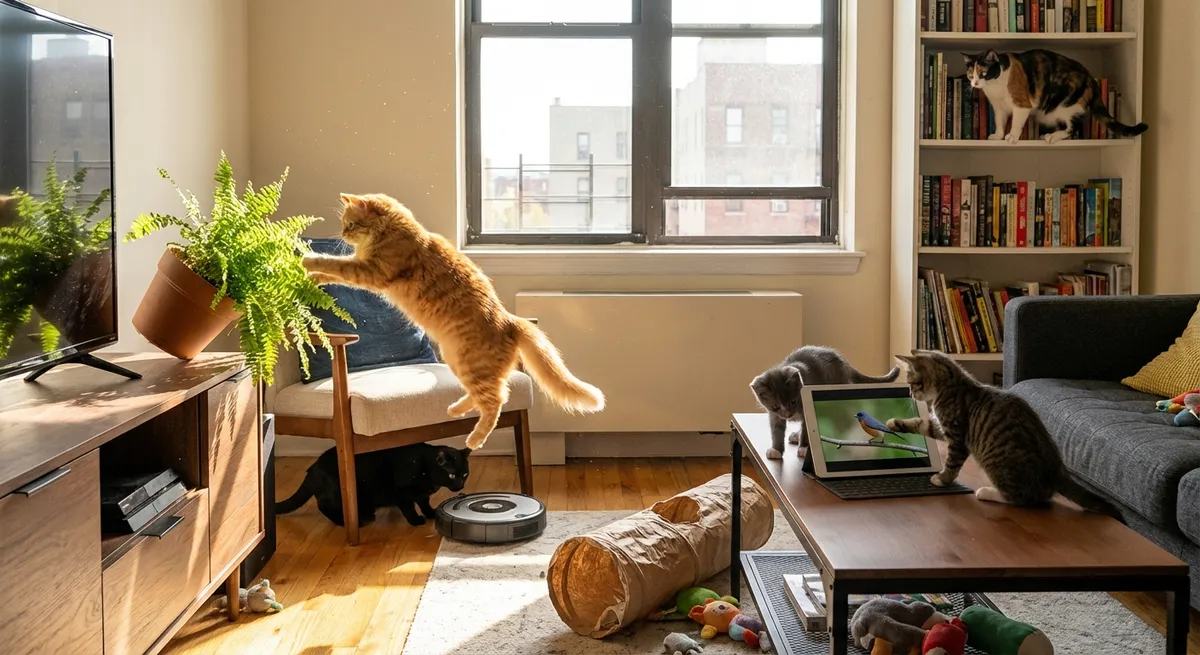
When I tried playing a new cat TV video once (birds in 4K, very fancy), her ears went full radar, tail stiff, pupils huge. Fun enrichment? Not for her. I switched it off and gave her a break. The tension melted out of her shoulders within seconds.
Tail: The Mood Barometer
I completely misread tails for years. A vertical tail with a little quiver? I thought she was annoyed. Nope — that’s her excited greeting.
Here’s how I read her now:
- Tail straight up with soft curve at tip: very confident, “Hi, you’re my person.”
- Tail puffed like a bottle brush: full threat mode, back off.
- Slow wagging tip only: she’s thinking, possibly overstimulated.
- Full sweeping tail thwaps: annoyed, don’t push it.
Once I started connecting tail + ears + eyes together instead of in isolation, I could predict her next move with freaky accuracy. It honestly feels like having subtitles turned on for your cat.
The Night I Tested “Speaking Cat” — And Actually Got a Response
One night at 1:17 a.m. (yes, I checked), my cat started her nightly opera outside my bedroom door. You know the one: the tragic ballad of “No One Has Ever Fed Me, Ever, In My Whole Life.”
Previously, I’d do one of two things:
- Give in and feed her (and accidentally reward the 1:17 a.m. performance), or
- Ignore her and lie there angry, listening to her yell.
Instead, I tried an experiment based on what I’d read about “extinction bursts” — when a behavior gets louder or more persistent right before it starts to fade because the reward stopped.
I:
- Got up once.
- Silently walked her back to the living room.
- No food. No treats. No eye contact. Just very calm, very boring human.
- Closed the bedroom door. Earplugs in. No reaction.
Nights 1–2: The yelling actually got worse.
Night 4: She yowled once, then gave up.
Week 2: She mostly stopped trying. She now does a casual “mrrrp?” at my alarm time instead.
By being extremely consistent and not pairing nighttime noise with food or attention, I “answered” her language with actions, not words. She adapted way faster than I expected, once I stopped sending mixed signals.
Playing Like a Predator: Why “Just Throwing a Toy” Wasn’t Enough
When I tested different types of play, I realized I’d been doing it completely wrong — like giving a pro basketball player a toddler hoop and saying “Have fun, champ.”
Cats are “obligate carnivores” with a hard‑wired predation sequence:
stalk → chase → pounce → grab → bite → dissect → eat → groom → sleepEvery time I just waved a toy directly in her face, skipping the “stalk” part, she’d get bored fast or go from 0 to murder mode on my ankles.
Once I started playing like prey instead of just “look at the string!”, everything clicked:
- I dragged wand toys away from her slowly, half‑hiding them behind furniture like a sneaky mouse.
- I paused motions so she could do the intense pupils‑dilated stare before pouncing.
- I let her “win” by catching and “killing” the toy often, not just chasing endlessly.
After these sessions:
- She scratched furniture less.
- She did fewer surprise ankle ambushes.
- She slept harder and meowed less aggressively for attention.
I also learned that vets actually recommend this predator‑style play as enrichment, especially for indoor cats. It mentally tires them out in a way random toy tossing never will.
The “Rude” Behavior That Turned Out To Be Completely Normal
Once I stopped taking cat behavior personally, a lot of things I’d labeled as “jerk moves” made way more sense.
Knocking Stuff Off Tables
I once watched her stare at a pen, slowly push it, then lean over the edge to track its fall like a scientist. That’s not spite — that’s hunting and physics testing.
Studies on feline cognition suggest cats can understand some basic cause‑and‑effect, and their play often mimics how they’d handle struggling prey. My cat isn’t a tiny villain. She’s just… doing field research.
The Sudden 3 a.m. Parkour
Those random hallway sprints? That’s crepuscular activity — cats are naturally most active at dawn and dusk. I shifted our hardest play session to late evening and noticed the midnight chaos toned down.
She still has the occasional wall‑run. But now it’s like once a week instead of nightly demon possession.
Ignoring Me… Then Randomly Shouting in My Face
When my cat “ignores” me all afternoon, then suddenly walks up and yells directly into my eyes, she’s not being dramatic (okay, maybe a little). She’s learned which behaviors get a reaction.
If yelling always earns snacks, while calm sitting doesn’t? Guess what she’ll choose.
Once I started rewarding quiet proximity — treats for just hanging out nicely — and not reacting to scream‑meows, she shifted her strategy. She’s… less of a tiny furry dictator now.
Limitations, Red Flags, and When “Cat Language” Needs a Vet Translator
I’m going to be very honest: body language can’t fix everything. There are behaviors that look “quirky” but are actually medical red flags.
From my experience — and backed up by vets and behaviorists — these are “don’t wait and see” moments:
- Sudden litter box changes (peeing outside box, straining, crying):
My friend’s cat did this and it turned out to be a urinary blockage. That’s an emergency situation, especially for male cats.
- Excessive hiding or sudden clinginess when they were previously stable:
When my cat turned unusually clingy and restless one week, it ended up being early arthritis pain. Cats hide pain ridiculously well.
- New aggression in a normally chill cat:
Could be pain, hyperthyroidism, or even vision/hearing changes.
- Over‑grooming or bald spots:
Stress, allergies, parasites, or skin problems — not just “she likes being clean.”
Behavior is data, but it’s not a full diagnosis. I’ve learned to treat sudden changes like a big blinking “check under the hood” light, not just “wow, she’s being weird.”
What My Cat Has Quietly Taught Me About Listening
Once I leaned into decoding her language, my cat stopped being this mysterious creature I occasionally annoyed and became more like a roommate who’s fluent in nonverbal communication.
Here’s what’s stuck with me the most:
- She always gives warnings before escalation. I just used to ignore them.
- Consistency from me = predictability for her = calmer cat.
- Enrichment and play aren’t “spoiling” — they’re outlets for a brain wired to hunt.
- Behavior isn’t random; it’s a conversation. If I don’t like her side of it, I need to look at what I’m “saying” with my actions.
And yes, I still get bitten sometimes. I still misread her. She still occasionally looks me dead in the eye and slowly pushes my pen off the table like a tiny chaos demon.
But now, most of the time, it feels like we’re on the same channel.
She’s not just a pet. She’s this small, opinionated predator who’s taught me that listening doesn’t always require words — just attention, pattern‑spotting, and a willingness to admit the cat was right all along.
Sources
- Cornell Feline Health Center – Feline Behavior Problems: Aggression – Overview of different aggression types in cats, including petting‑induced aggression and redirected aggression
- American Association of Feline Practitioners – Environmental Needs Guidelines – Detailed explanation of play, enrichment, and stress reduction for indoor cats
- International Cat Care – Cat Body Language – Breakdown of tail, ear, and eye signals and what they usually indicate in context
- RSPCA – Understanding Cat Behaviour – Practical explanations of common “problem” behaviors like scratching, night activity, and vocalisation
- American Veterinary Medical Association – Cat Ownership and Care – Guidance on when behavior changes signal medical issues and the role of veterinary checkups