The “Chaos Drawer” Cure: How I Accidentally Made My Home Feel Twice as Calm
I didn’t start with a grand design plan. I started with one humiliating moment: a friend opened that kitchen drawer—you know the one—and a tidal wave of rubber bands, dead batteries, and soy sauce packets came spilling out. She just said, “Oh. You have a chaos drawer too.”
That afternoon I made a tiny change that snowballed into something wild: my home started to feel calmer, quieter, even bigger… without buying new furniture or repainting a single wall. It wasn’t minimalism. It wasn’t organizing porn from Pinterest. It was something smaller and way more sneaky: I started deleting visual noise.
And once I tested this “visual quiet” idea in one room, I couldn’t unsee it anywhere else.
What I Mean by “Visual Noise” (And Why Your Brain Is Exhausted)
When I first heard a designer say “this room has a lot of visual noise,” I thought it was just fancy decorator-speak. Then I tried a little experiment at home: I stood in my living room, slowly turned in a circle, and literally counted how many different things my eyes landed on in five seconds.
Cords. Shoes. Mail. Busy prints. Open shelving showing every mug I own. A laundry basket pretending to be decor. My brain felt tired just doing a casual spin.
Here’s the thing: our brains are constantly processing clutter as information. Cognitive scientists call it “stimulus load.” The more your eyes have to scan, the more mental energy it quietly sucks away. I later found a 2011 study from UCLA’s Center on Everyday Lives of Families showing that high household clutter levels were linked to increased cortisol (yep, the stress hormone) in mothers. I read that and thought, “So my countertop is literally stressing me out.”
When I tested the “visual noise” theory, I didn’t declutter everything. I just hid stuff. I grouped objects. I reduced color chaos. The amount of stuff was similar…but my home immediately felt calmer.
That’s when it clicked: you don’t necessarily need less; you need your brain to see less at once.
The Three-Second Scan Trick That Changed How I Set Up Every Room
I started using what I now call my three-second scan. It sounds silly, but it’s become my secret weapon.
Here’s how I do it:
- I stand at the doorway of a room.
- I close my eyes, count to three, then open them.
- Whatever my eyes hit first… that’s the “loudest” thing in the room.
When I tested this on my own spaces, I kept seeing the same problems:
- One surface that looked like a yard sale
- Way too many tiny items in open view
- Random color explosions (five colors fighting for attention)
- Stray cords and wires screaming from the corners
In my kitchen, the first thing my eyes hit was a cluttered counter: air fryer, toaster, blender, knife block, mail, keys, half a lemon in a bowl for some reason. I didn’t own too much kitchen gear—I just had too much visible at the same time.
So instead of asking, “What can I get rid of?” I asked, “What can I make disappear?” Not permanently—just visually.
I started with:
- Moving the air fryer to a lower cabinet
- Stashing the blender in a pantry
- Dropping keys and mail into one closed box near the door
- Leaving only a cutting board, a plant, and a bowl of lemons out
Same life, same habits, same gadgets. But the mental volume dropped from a 9/10 to a 4/10.
A few days later, something weird happened: I actually wanted to wipe the counter at night. The empty space made me feel like I was “finishing” the day. That might sound minor, but small wins like that cascade into better routines.
How I Built “Calm Zones” Without Turning My Home Into a Beige Hotel
I’m not a minimalist. I love books, color, and weird little thrifted objects that make no design sense. So I was scared that chasing “visual quiet” would turn my home into a bland, beige hotel and erase my personality.
That didn’t happen. What actually happened: I gave my stuff a chance to shine.
I tried this in my living room first. Here’s the before:
- Two bookshelves crammed with books, candles, random souvenirs, old mugs
- A coffee table layered with coasters, remotes, magazines, a candle, and “stuff that has no home”
- A gallery wall with every frame style known to mankind
When I looked at it like a designer would, I realized there was no negative space—no areas of visual rest. Interior designers talk about “breathing room” around objects; I used to think that was just artsy language. Once I tested it myself, it felt like the visual version of silence between songs.
What I changed:
- I dedicated one shelf to be visually quiet: just books, spines color-grouped, nothing on top
- I created a “loud” shelf: travel souvenirs, a bright vase, and my weird flea-market lion statue all together instead of spread across the room
- I used a tray on the coffee table so remotes, coasters, and a small candle became one visual item, not seven
- I edited the gallery wall so all frames were black or wood, and left a blank section of wall on purpose
The result? My favorite objects stood out more, and the room felt more… grown-up? Still me, but with fewer visual arguments happening.
The underrated hero in all this is containment. A basket, tray, or lidded box doesn’t just hide things—it tells your brain, “This mess has boundaries.” Research on visual perception backs this up: grouping items and creating clear edges help our brains process scenes faster and with less effort.
So now I think in “zones”:
Loud corner. Quiet corner. Loud wall. Quiet wall. It’s like building a playlist instead of blasting every song at once.
The Sneaky Power of Hiding Things (Without Becoming a Storage Goblin)
When I say “hide things,” I don’t mean stuffing everything in a closet and hoping your guests don’t open the door. I tested that approach in my twenties. It backfired.
I’ve learned there’s a difference between clutter storage and intentional storage:
- Clutter storage = random junk drawers, mystery bins, “temporary” piles that become permanent
- Intentional storage = specific, labeled, easy-to-reset homes for the stuff you actually use
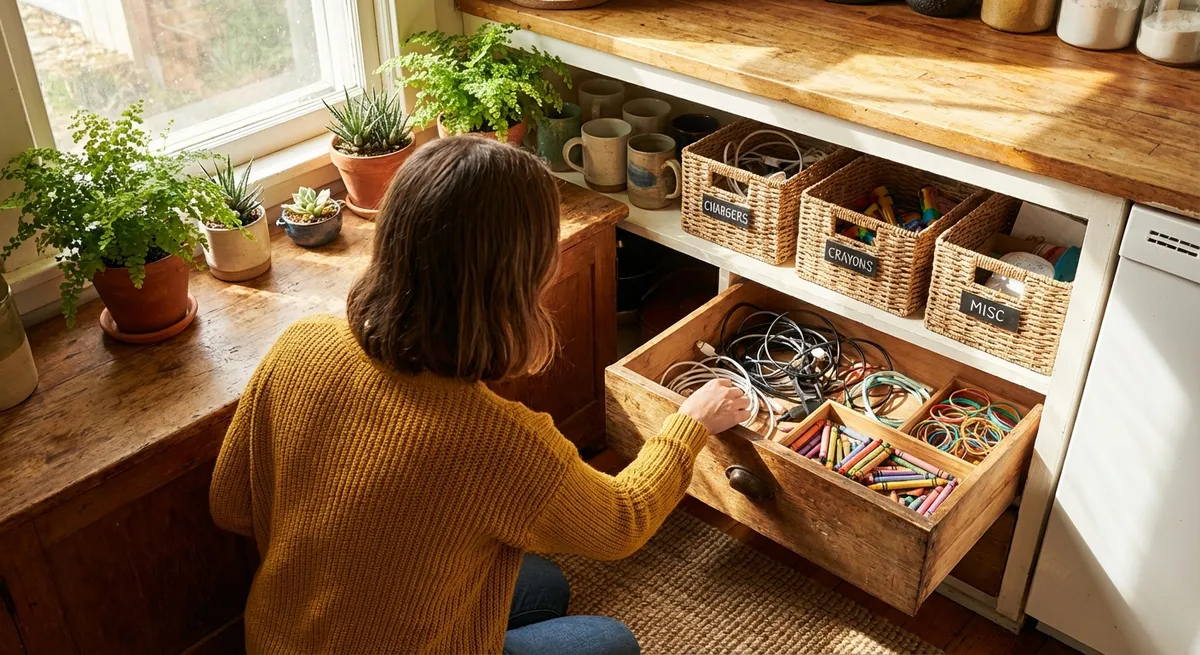
When I attacked my infamous kitchen chaos drawer, I didn’t aim for Pinterest perfection. I literally dumped it out on a towel and sorted by category:
- Tools (tape measure, mini screwdriver)
- Tech/random (chargers, batteries)
- Paper (coupons, business cards, mystery notes)
- Absolute trash (half of it, let’s be honest)
I used three small containers inside the drawer and decided each category got one container, max. If something didn’t fit, it had to graduate to real storage (toolbox, office drawer) or leave the house.
The funny part? I didn’t actually get rid of that much. I just stopped mixing completely unrelated items. And the drawer stopped yelling at me every time I opened it.
Around the house, the best “hiding spots” ended up being:
- Closed baskets for blankets and toys in the living room
- A narrow cabinet by the entry for shoes instead of a shoe explosion by the door
- Opaque bins in the bathroom under-sink cabinet instead of 20 bottles standing in the open
- A simple file box for mail, receipts, and “paper I don’t know what to do with yet”
Every time I added one more layer between my eyes and my stuff, the room instantly felt upgraded. It reminded me of something Marie Kondo said about “respecting your belongings by giving them a proper home.” It’s cheesy, but once I tested it, it didn’t feel cheesy—it felt… accurate.
The downside: this only works if the hiding places are easy to use. If you need to move three things to put one thing away, you won’t. In my experience, the winning formula is: one motion to open, one motion to drop it in, done.
When “Cozy” Is Actually Chaos: Playing With Color and Pattern
I used to blame my small rooms for feeling cramped. Then I learned how much of that “small” feeling was just my color and pattern choices screaming over each other.
When I say “visual quiet,” I don’t mean everything has to be white and beige. But if every surface has a different pattern and every object is a new color, your brain is doing overtime.
I started small in my bedroom. At that point, it was a riot: a multicolored duvet, patterned throw pillows, bright art, a busy rug, and random stuff stacked on the nightstand.
Here’s how I calmed it down without making it boring:
- I picked one main color for the room (soft blue), one neutral (warm white), and one accent (rust/orange)
- I chose a solid duvet cover and let the pattern live on the throw pillows and rug instead of everywhere
- I made my nightstand a “visual quiet zone”: lamp, book, one coaster. That’s it.
- I kept the art above the bed simple and large instead of a cluster of small frames
Design-wise, that’s just a simple color palette and restraint with pattern. Mentally, it felt like going from a crowded café to a calm lounge.
Research from environmental psychology backs this up: environments with coherent color schemes and reduced visual complexity are often perceived as more restorative. That’s why spas don’t usually have six clashing colors and ten different prints.
The trade-off: you do have to say no to some fun stuff. I learned the hard way that just because I like a patterned pillow in the store doesn’t mean my bedroom needs it. My new rule: if a new item doesn’t fit my room’s “two neutrals + one color” palette, it has to be an intentional focal point—not just random noise.
Tiny Daily Habits That Keep the Calm Going (Without Feeling Like a Chore)
Once my spaces felt calmer, the next test was: can I actually maintain this as a normal, slightly lazy human?
I’ve tried the “I will become a new person and always put things away immediately” approach. It lasted about four days. What worked better was building micro-habits that protect visual quiet without requiring a personality transplant.
Here are the ones that stuck for me:
- The 2-minute reset before bed in the living room. I don’t deep clean. I just: clear the coffee table, fold the blanket, toss stray items into the right basket. It’s like tucking the room in.
- The “one in, one out” rule for small decor. If I bring home a new candle, frame, or knickknack, something else has to either be stored or donated. It forces me to curate, not hoard.
- Mail triage at the door. Junk mail goes straight to recycling. Real mail goes into a single tray, not ten different surfaces. Once a week I deal with the pile.
- Countertop amnesty zones. Instead of promising myself I’ll keep every surface empty (lie), I chose two “allowed clutter” spots: one tray in the kitchen, one in the entry. They catch the daily mess so it doesn’t spread everywhere.
The honest downside: the first week or two, these habits felt annoying. But after a month, my future self kept thanking past me. Walking into a room that doesn’t visually attack you after a long day? That’s addictive.
And no, my place isn’t magazine-perfect. I still get laundry mountains, stray shoes, and the occasional rogue Amazon box colony. But the baseline calm is there, and it’s surprisingly resilient.
Why This Matters More Than Just Aesthetics
When I started messing with visual quiet, I thought I was just chasing a nicer-looking home. Unexpectedly, it started affecting how I felt and functioned:
- I cooked more often because my kitchen didn’t feel like a war zone
- I read more at night because my bedroom felt like a place to rest, not to scroll
- I cleaned faster because there was less random stuff to move just to wipe a surface
There’s decent evidence for this, beyond my little experiment. Studies on attention restoration suggest that environments with lower visual clutter help our brains recover from mental fatigue faster. Research from the Princeton Neuroscience Institute found that physical clutter in our surroundings competes for our attention, resulting in decreased performance and increased stress.
Do you need science to tell you your laundry chair is stressing you out? No. But it’s validating to know your instincts aren’t wrong: your home really can mess with your head—or help it out.
I’m not here to preach minimalism or a specific aesthetic. I’m more interested in this question:
What happens when your home stops yelling at you?For me, the answer was: I had more energy for the parts of life that actually matter.
Conclusion
The secret wasn’t owning less or becoming a totally different person. It was learning how to turn down the visual volume with tiny, boring, repeatable moves: hiding things smarter, grouping what I keep, giving objects breathing room, and staying loyal to a simple color story.
If you’re curious where to start, try this: pick one room, stand in the doorway, do the three-second scan, and ask yourself, “What’s yelling the loudest?” Don’t redecorate your whole life—just quiet that one thing.
That’s how I went from a chaos drawer embarrassment to a home that finally feels like it has an off switch.
Sources
- UCLA Center on Everyday Lives of Families (CELF) – Research on household clutter, family life, and stress, including studies linking cluttered homes to elevated cortisol levels.
- Princeton Neuroscience Institute – “Interactions of Top-Down and Bottom-Up Mechanisms in Human Visual Cortex” – Explores how multiple visual stimuli compete for attention, supporting the idea that clutter impacts focus and mental load.
- American Psychological Association – “The Hidden Cost of Clutter” – Discusses psychological impacts of clutter and its relationship with stress and well-being.
- Harvard Graduate School of Design – Environmental Psychology Resources – Provides insight into how built environments, including homes, affect mood, behavior, and cognitive function.
- Mayo Clinic – Stress Management Basics – General overview of stress, how it manifests, and lifestyle changes (including environment) that can help manage it.