How I Turned Solo Board Gaming Into My Favorite “Offline Escape”
I used to think board games were only fun if you had a full squad, snacks, and a Saturday night. Then I stumbled into solo board gaming almost by accident—and it quietly became my favorite way to unplug, reset my brain, and still feel like I did something interesting with my evening.
If you’ve ever thought, “I’d love to play something, but I don’t have people around” or “I don’t want another screen hobby,” this might be the weirdly-perfect middle ground you didn’t know you needed.
The Night I Realized I Didn’t Need Other People To Have Fun (At A Table)
I recently discovered solo board gaming because my friends bailed on game night for the third time in a month. I was staring at a copy of Wingspan on my table thinking, “Well… what now?” Out of curiosity, I googled “Can you play Wingspan alone?” and fell into a rabbit hole of rulebooks, variants, and people online passionately arguing about something called an “automata deck.”
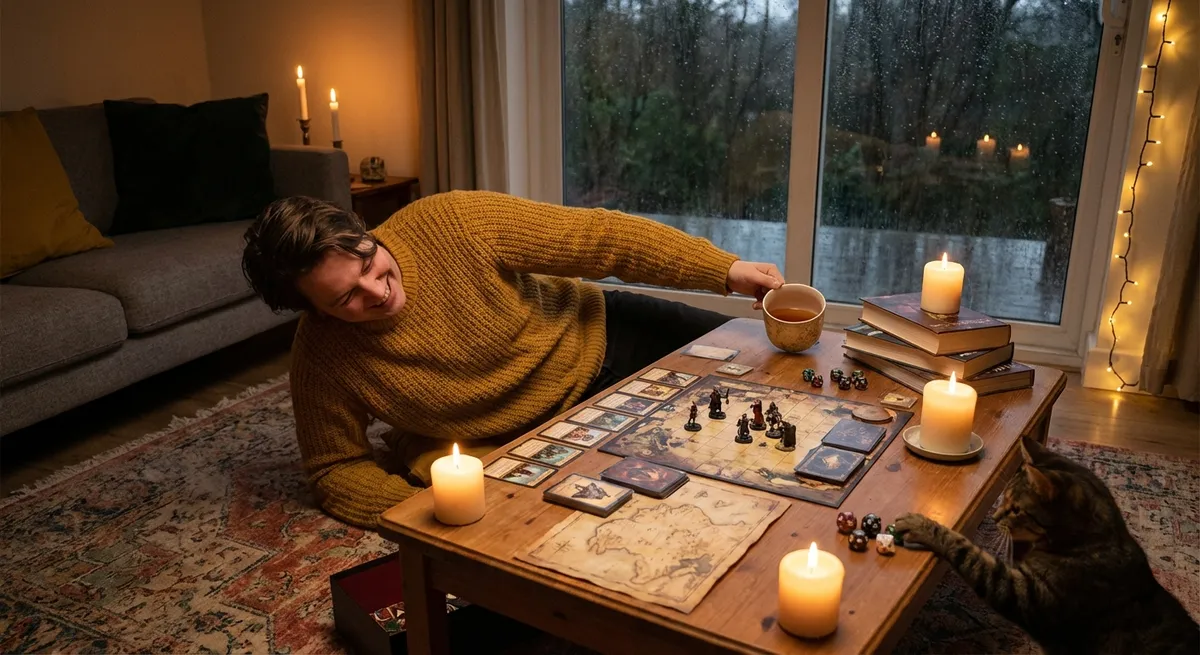
When I tested my first solo session, it felt bizarre at first. No one to explain my genius moves to. No one to trash-talk. Just me, a cup of tea, and a cardboard AI player quietly trying to ruin my plans.
By round three, I realized two things:
- I’d completely forgotten about my phone.
- My brain felt that “good tired” feeling you get after a solid puzzle or a long, satisfying walk.
In my experience, that’s the magic of solo board gaming. It’s not “settling” for less social fun. It’s a different kind of hobby: half strategy, half meditation, with just enough chaos to keep you hooked.
What Solo Board Gaming Actually Looks Like (It’s Not Just Sad Uno For One)
Whenever I talk about this hobby, someone always jokes, “So you just play both sides of Monopoly?” Absolutely not. That sounds like a psychological experiment gone wrong.
Modern solo board games are built very differently. A lot of newer titles include an official solo mode designed from the ground up—usually some form of “automata” (a fancy term for non-human opponent rules), score-chasing, or puzzle scenario.
Here’s what that feels like in practice from my table:
- Automata opponents: When I play Scythe solo, a special deck of cards controls the enemy factions. Each card tells me exactly what the AI does—move here, attack there, grab this resource. I’m not pretending to be two players; I’m reacting to a semi-unpredictable opponent with its own rhythm.
- Puzzles instead of people: In Spirit Island, the solo mode turns the game into this intense puzzle about pushing back invaders before everything catches fire. It’s less “beat your friends” and more “beat the system.” When I finally pull off a win at higher difficulty levels, it feels like solving a Rubik’s Cube that hates me personally.
- Narrative, choose-your-own-chaos: Games like Arkham Horror: The Card Game or Gloomhaven: Jaws of the Lion become story time with extra stress. I once spent a Saturday afternoon trying (and failing) to stop a cult in Arkham Horror and still walked away thinking, “That was such a good story,” even though my character basically emotionally collapsed in a haunted library.
In my experience, the key difference is this: solo board gaming isn’t about pretending you have friends—it’s about giving your brain something to chew on that isn’t just more scrolling or streaming.
Why It Became My Favorite “Low Social Battery” Hobby
I love people… I just don’t always have the energy to coordinate with them. Solo board gaming quietly solved a bunch of problems I didn’t realize were blocking me from enjoying my time off.
1. Zero scheduling frictionThere’s no “Hey, what time works for everyone?” followed by 37 messages and a last-minute cancellation. If I’ve got 45 minutes between dinner and bedtime, I can pull out Cascadia, shuffle, and start. No prep, no group chat logistics, no guilt.
2. Built-in mindfulness (without calling it that)I’ve noticed something weird: when I’m mid-turn in a solo game, my brain stops doing the anxious multi-tab thing. I’m just thinking:
- “If I place this tile here, I can connect that habitat.”
- “If the automa draws that card, I’m screwed—so I should prepare for that.”
Psychologists have actually studied how hobbies like puzzles and games boost what they call “flow” and well-being. A large 2021 survey published in Nature journals found that engaging leisure activities can significantly reduce stress and improve mental health, especially when they’re immersive and screen-free.
I didn’t get into this for the wellness angle, but I can feel the difference on weeks when I play vs. weeks when I don’t.
3. You can stop mid-game without being That PersonWhen I play Terraforming Mars solo, I sometimes leave it half-finished on my table and come back later. Try doing that with four friends waiting on you. The flexibility makes it way easier to fit into real life.
4. It genuinely boosts your “game night” skillsOdd perk: I’ve gotten demonstrably better at strategy games with friends because I’ve “scrimmaged” against solo modes. When I teach Wingspan or Azul now, I can explain not just the rules, but actual tactics because I’ve tested them alone. It’s like doing drills before pickup basketball.
How I Pick Games That Actually Work Solo (And Don’t Just Sit On A Shelf)
Not every board game shines solo. I’ve bought a couple that were… fine, but felt like trying to do karaoke without music. Over time, I’ve figured out a pattern that helps me choose better.
What’s worked for me:- Official solo mode in the rulebook: I lean heavily toward games that include a dedicated solo mode designed by the original team. When a designer like Jamey Stegmaier (Scythe, Viticulture) or Elizabeth Hargrave (Wingspan) includes solo rules, you can feel the polish.
- Puzzle-forward games: Tile-laying games like Cascadia or Cartographers play beautifully solo because they’re already about optimization. You’re not losing anything without human opponents; you’re just racing your own brain.
- Campaign or story games: I underestimated how good it feels to have a hobby that remembers “where you left off.” Gloomhaven: Jaws of the Lion hooked me because when I pack it up, my characters and progress are waiting next time—exactly like a video game save file, but with more cardboard and less blue light.
- Pure negotiation/social deduction: Games like Codenames or Avalon are built around reading people. Alone, there’s just nothing to read. You can’t out-bluff your own cat.
- Party games tied to group energy: A solo game of Cards Against Humanity is just… journaling with extra steps. The “fun” is the reactions, which don’t exist when you’re alone.
When I’m unsure, I check solo-specific reviews on sites like BoardGameGeek and The Dice Tower. You quickly see which games the solo community strongly loves or politely tolerates.
The Downsides Nobody Mentions (That I Definitely Felt)
I’m not going to pretend this hobby is perfect cardboard enlightenment. There are some real cons I bumped into:
1. The learning curve can be brutalMy first solo attempt at Spirit Island was basically me reading the rulebook for 30 minutes, playing for 10, and realizing I’d done everything wrong. Some modern games are complex enough that learning them alone can feel like studying for a test no one assigned.
What helped: watching a YouTube “playthrough” while setting up. Seeing someone physically move the pieces made everything click way faster than text alone.
2. Analysis paralysis is real when you’re only waiting on yourselfWith no one tapping the table or joking “Your turn, dude,” I’ve caught myself staring at cards for way too long. In solo modes, nothing stops you from overthinking every move.
My fix is imperfect but helpful: I quietly set a “vibe timer” in my head. If I’m stuck for more than 60–90 seconds, I just pick something and live with it. The game flows better, and honestly, the chaos makes for better stories.
3. It can get expensive if you don’t pace yourselfOnce I realized how many games supported solo play, my online cart grew faster than my available shelf space. According to an industry report from The NPD Group, tabletop game sales have been climbing hard since around 2016, and you can feel that hype in your wallet.
I had to make a rule: I don’t buy a new game until I’ve played the last one at least three times solo. That one guideline has saved both money and clutter.
4. It doesn’t fully replace social connectionAs much as I adore solo gaming, there are nights where I’m like, “Okay, I actually do miss yelling at my friends over cardboard.” This hobby is great for recharging and escaping, but it’s not a replacement for human connection. It’s more like: a powerful side quest, not the main story.
How To Try It Without Spending A Ton Or Getting Overwhelmed
If anything here is pinging your curiosity, here’s how I’d test-drive solo board gaming based on what worked for me (and what absolutely didn’t).
Start lighter than you thinkWhen I jumped straight into heavy strategy games, I almost scared myself off. The games that hooked me early were:
- Cascadia – Cozy, intuitive, and still surprisingly thinky. You’re building habitats and wildlife patterns, and the solo mode is basically a chill but focused puzzle.
- Cartographers – A “roll and write” map-drawing game where the solo mode just tweaks scoring. Very low setup, high replay.
Both are simple enough to learn in under 20 minutes, but deep enough that you don’t get bored after two plays.
Borrow or try before you buyI tested a couple of games at a local board game café before committing. Some libraries even lend board games now—my city’s library has an entire wall of them. It felt way less risky to experiment this way.
You can also find official “print and play” samples for some games from publishers’ websites. It’s not glamorous, but it’ll tell you if your brain likes that style.
Use online helpers without shameI used to feel weird about checking rules and strategy videos mid-game. Now it’s just part of the ritual. Sites like BoardGameGeek often have:
- Solo variants created by the community
- Rule clarifications that save your sanity
- Difficulty tweaks if the base solo mode is too punishing or too easy
Once I stopped treating the rulebook as sacred scripture and more like a suggestion with upgrades, I enjoyed myself a lot more.
The Unexpected Flex: Being “The Game Person” In Your Friend Group
The funniest side effect of all this? Playing alone made me the unofficial game concierge in my circle.
Because I’d already learned the rules solo, I could:
- Teach games quickly without burying everyone in details
- Choose the right game for the vibe (“Okay, you hate long rules explanations, so we’ll do this one”)
- Smooth over conflicts because I knew where the rules got fuzzy
Game nights went from “Ugh, learning something new” to “You pick, we trust you.” That felt weirdly satisfying.
And on nights when nobody’s free or I’m just not in the mood to socialize, I still get to crack open a box, set up a world, and play something that feels engaging and disconnected from the constant noise of my phone.
I went looking for a way to fill quiet nights, and I accidentally found a hobby that makes my alone time feel genuinely rich instead of just “not scrolling.”
If you’ve ever stared at your screen and thought, “I want to do something, but I don’t know what,” solo board gaming might be exactly that “something.”
Conclusion
I started solo board gaming because my friends canceled, and I stayed because it turned out to be the most satisfying offline ritual I’ve added to my life in years. It’s part strategy workout, part mental reset, and part private story time where cardboard villains ruin my day and I love them for it.
It’s not perfect—there’s a learning curve, it can be a money sink if you let it, and it won’t replace real social connection. But as a hobby that makes alone time feel intentional, interesting, and weirdly memorable? It’s hard to beat.
If you try it, start small, let yourself mess up the rules, and remember: no one’s watching. Which, for once, is exactly the point.
Sources
- BoardGameGeek – Wingspan – Details on solo modes, player reviews, and community variants for a popular modern board game
- Stonemaier Games – Official Scythe FAQ and Automa Info – Explains how automa (AI opponents) work and how they’re designed for solo play
- NPD Group – Board Games and Puzzles Market Insights – Industry data and reports on the growth of tabletop gaming and puzzle hobbies
- Nature – “The effects of leisure activities on mental health” (Scientific Reports) – Research discussing how engaging leisure activities relate to reduced stress and improved well-being
- American Psychological Association – Why leisure activities are important for health – Overview of the psychological and health benefits of hobbies and structured leisure time