How I Accidentally Became Obsessed With DIY Miniature Worlds
I thought tiny houses were the trend… then I found tiny everything. I’m talking full kitchen setups that fit on your palm, working lamps the size of a grape, books you can barely pinch with two fingers. I recently fell down the rabbit hole of DIY miniatures, and it turned a random Sunday hobby into the most relaxing, weirdly emotional thing I’ve done in years.
If you’ve ever wanted a hobby that lets you be an architect, interior designer, engineer, and chaotic goblin god of a 1:24-scale universe, this is your sign.
The Moment a “Cute Kit” Turned Into a Full-On Obsession
My gateway drug was a gift: one of those DIY miniature room kits you see on TikTok. The box looked harmless. “Relaxing hobby!” the label claimed. Lies. That thing ate my entire weekend and a worrying amount of my personality.
When I opened it, there were hundreds of tiny pieces: laser-cut wooden panels, microscopic books, fake plants with leaves like confetti. I remember thinking, “No way this all becomes that cozy café picture on the front.” But when I started gluing tiny chair legs together and folding paper into books, my brain went into a weird, peaceful tunnel-vision mode.
About three hours in, I realized I hadn’t checked my phone once. No doomscrolling, no buzzing notifications, just me, a cup of now-cold coffee, and a microscopic lamp that refused to behave.
By the time I finished, I had:
- A whole fictional café with a name and backstory
- A new respect for anyone who can cut straight lines
- A fresh addiction
That “just for fun” kit turned into me staying up late watching Japanese miniature food channels, learning about HO scale vs 1:12 scale, and stalking LED light strips meant for dollhouse wiring.
Why Building Tiny Worlds Is Ridiculously Good for Your Brain
Here’s what surprised me most: this wasn’t just cute. It felt… therapeutic.
I dug into the science later, and it actually checks out. When I’m painting a dresser smaller than my thumb, my brain shuts up in the best way. It’s that “flow state” psychologists talk about—when you’re totally absorbed in something slightly challenging but not impossible.
Researchers like Mihaly Csikszentmihalyi (the guy who basically popularized the term “flow”) have written for years about how that state boosts happiness and reduces stress. Miniatures are like a cheat code to get there: they demand focus, but the stakes are hilariously low. Worst case? You superglue your fingers together.
In my experience, a few things happen every time I work on a miniature build:
- My anxiety drops because I’m 100% focused on “does this tiny plant look better on the shelf or in the corner?”
- I get this tangible hit of accomplishment when a room comes together. Real-life tasks can drag on forever; a mini room has a clear “done.”
- It sneaks in problem-solving and creativity—tiny wiring, hidden seams, color matching—without feeling like work.
There’s also a nostalgia factor I didn’t expect. It feels a little like playing with dollhouses again, but with adult-level craftsmanship and zero judgment. And for some people, especially in therapy contexts, creating miniature scenes has even been used to safely explore emotions and memories (there’s actually a whole field called “sandplay therapy” that uses similar principles).
Picking Your Miniature “Personality”: From Cozy Rooms to Chaos Goblin Labs
Not all miniature hobbies are the same vibe. When I tested a few different styles, I realized they attract totally different types of people—and moods.
Here are a few "mini-world personalities" I’ve seen (and mildly become):
1. The Cozy Interior Designer
You love: cottagecore, mood boards, rearranging your room at 1 a.m.
You’ll be obsessed with dollhouse rooms, mini apartments, tiny cafés, and studios. Think wallpaper samples, wood paneling, little rugs, and coordinating color palettes. When I build these, I end up naming my imaginary tenants and assigning them careers. “This is Lina’s reading nook, she bakes sourdough and hates open-plan offices.”
Pros:
- Deeply satisfying “before and after” feeling
- Super Instagrammable
- Easy to display on shelves
Cons:
- Can get expensive if you buy pre-made furniture
- Requires patience with measuring and right angles (my nemesis)
2. The Goblin Engineer
You love: taking things apart, LEDs, “will this work if I…” energy.
You’ll get hooked on wiring working lights, creating moving parts, and hiding tiny mechanisms. I once spent an entire evening figuring out how to make a lamp light up without visible wires. (Spoiler: magnet wires and lots of swearing.)
Pros:
- Feels like real engineering in pocket-size
- Wild satisfaction when something actually turns on or moves
- Great gateway into electronics
Cons:
- More tools required (soldering irons, wire strippers, etc.)
- Higher frustration potential when circuits fail or LEDs blow
3. The Miniature Food Artist
You love: cooking shows, ASMR videos, icing videos you watch at 2 a.m.
You’ll thrive making polymer clay food—tiny sushi, cakes, boba cups, ramen bowls. I tried a set of realistic mini macarons and literally squealed. It’s like being a pastry chef in the world’s smallest bakery.
Pros:
- Fast projects you can finish in an evening
- Perfect for jewelry, keychains, or decor
- The “wait that’s not real?!” reaction never gets old
Cons:
- Needs baking (polymer clay cures in an oven)
- Easy to get obsessive over “perfect realism”
4. The Lore Builder
You love: D&D, fantasy novels, worldbuilding, Skyrim mods.
Miniature terrain, tabletop scenery, tiny taverns, overgrown ruins—this is your playground. I made a mossy wizard tower once and spent more time deciding who lived there than painting the stones.
Pros:
- Amazing crossover with tabletop games (Warhammer, D&D, etc.)
- Lots of room for storytelling and custom details
- Cheap materials if you use foam, cardboard, and paint
Cons:
- Can eat space quickly (terrain pieces aren’t always tiny-tiny)
- You’ll start hoarding “trash” because “this bubble wrap could be clouds”
What I Wish I Knew Before My First Mini Build
Here’s the part nobody told me when I started: those “easy starter kits” don’t feel easy when you’re holding tweezers for four hours straight. I almost rage-quit my first build because of three things—glue, lighting, and time.
The Glue Reality Check
Every miniature creator has a glue they swear by like it’s their zodiac sign. When I tested a few, here’s what actually mattered:
- Wood + structure: Wood glue or a strong PVA (white) glue worked best for walls and floors.
- Instant hold: Gel superglue saved my sanity for stubborn pieces, but it can fog clear plastic and your fingertips.
- Paper + fabric: Tacky glue was gentler and didn’t warp stuff as much.
Pro tip I learned the hard way: less is more. If you glob on glue, it squishes out and looks messy—especially under tiny chairs.
The “This Will Only Take an Hour” Lie
The box said “Assembly time: 8–10 hours.” I thought, “So, an afternoon.” Nope. Add at least 30–40% if you’re new.
Between drying times, fixing mistakes, and just admiring how cute the tiny mugs are, my first kit took closer to 15 hours spread across a week. And honestly, that ended up being the magic—it forced me to slow down and look forward to the next piece.
Lighting: Optional but Game-Changing
When I first saw wiring diagrams in the instructions, I almost skipped the lights completely. But when I finally tested it, the difference was massive. A tiny room with a warm glow looks alive. Without it, it’s… just a very nice tiny room.
Most kits use:
- Pre-wired LEDs attached to tiny lamps
- A battery pack you hide under the base
- Thin magnet wires you have to route through walls or bookshelves
Is it fiddly? Yes. Is it worth the finger cramps? Also yes. Just be realistic—if you hate dealing with cables in real life, start with a non-electric kit and add LED candles or fairy lights later.
How to Start Without Turning Your Desk Into a Craft Store
When I got obsessed, my first instinct was to buy every tool TikTok recommended. I’m glad my bank account stopped me. You don’t need a professional setup to build your first tiny world.
What worked best for me was a “start stupid simple” approach:
- Begin with a single-room kit, not a full house. Bedrooms, studies, and shops are perfect. You’ll learn floors, walls, furnishing, and decor without needing a PhD in roof angles.
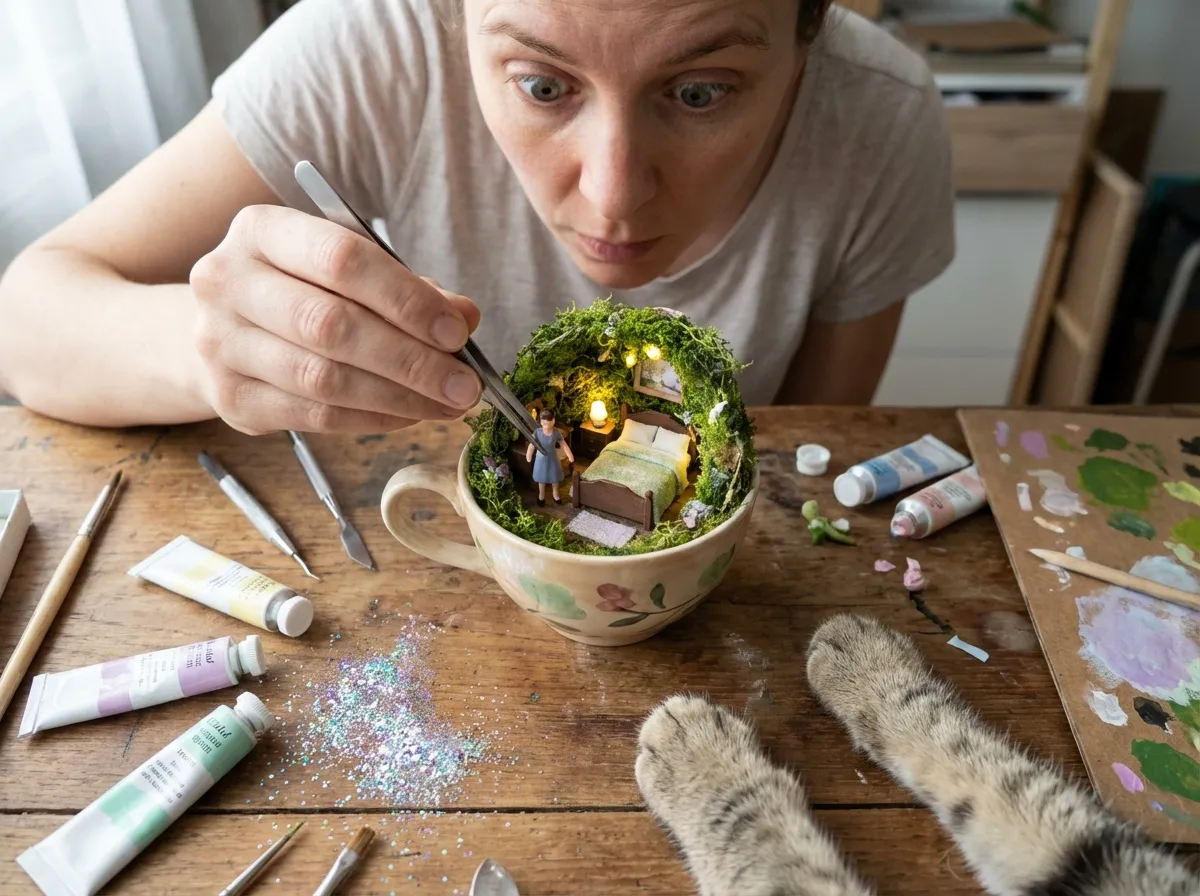
- Use what you have first. I built my first room with: basic scissors, tweezers from an old first-aid kit, school glue, a nail file, and a craft knife. Upgrades came later.
- Embrace “good enough” on your first build. My first bookcase was crooked. My first plant looked like a lettuce accident. When I stopped chasing perfection and focused on “does this make me smile?”, the whole thing became less stressful and way more fun.
- Pick a theme that emotionally hooks you. My second build was a tiny nighttime writing studio, and I weirdly felt attached to it, like I’d built a version of my dream workspace. That connection made me push through the annoying parts.
Cost-wise, you can get a decent starter kit in the $20–$60 range, depending on brand and complexity. If you go fully custom from scratch, it can be cheaper… or much more expensive, depending on how deep you go on materials.
The Dark Side: When Tiny Turns Toxic
As much as I love this hobby, I’d be lying if I said it’s all cozy vibes and miniature pastries. There are some downsides I had to learn to manage:
- Perfectionism creep. Online, you’ll see miniatures with insane realism—dust on shelves, visible wood grain, even tiny fingerprints on “glass.” Comparing your first attempts to those can suck the joy right out. I had to actively remind myself that I was doing this for fun, not a museum exhibit.
- Space and dust. These things collect dust like nobody’s business. One shelf of finished pieces becomes three, and suddenly your “minimalist aesthetic” is gone. I ended up getting a couple of cheap clear display cases to keep them from turning into cobweb magnets.
- Eye strain and hand fatigue. Long sessions hunched over tiny pieces aren’t kind to your body. I only realized how tense I’d been when my shoulders started protesting. Taking breaks, stretching, and getting a simple magnifying lamp helped a ton.
- Analysis paralysis. There are SO many options—scales, styles, materials—that you can get stuck in “research mode” and never actually build anything.
The trick, at least for me, was treating miniatures like comfort food, not a performance. Some builds are ambitious and detailed; others are quick and a little janky. Both count.
Why This Hobby Is Weirdly Social (Even If You Build Alone)
Miniatures feel like a solo hobby, but I’ve had more genuine online conversations about glue than about half the “social” apps on my phone.
When I started posting progress pics, a few things happened:
- People who’d never heard of the hobby suddenly wanted to try it.
- Experienced builders showed up in the comments with tips like, “If your paper’s warping, seal it first” or “Use pastels for aging wood.”
- I found niche communities—on Reddit, Instagram, and YouTube—where people shared build diaries, mistakes and all.
There’s also something disarming about tiny stuff. Friends who’d never care about a big renovation project will happily zoom in on your 3 cm potted plant and ask, “Wait, how did you make that dirt?”
If you’re more offline, there are dollhouse and miniature clubs, conventions, and local craft meetups in a lot of cities. The International Guild of Miniature Artisans even certifies master-level artisans, which blew my mind. That’s how deep this world goes.
Why I’m Sticking With Tiny Worlds (And Why You Might, Too)
I’ve tried a lot of hobbies—rock climbing, digital art, baking, language apps that ghost me after week three. Miniatures are the one thing that consistently pulls me back.
When life feels chaotic, there’s something reassuring about a world where every object has a place, every light can be turned on with a tiny switch, and mistakes can usually be covered with a rug or a potted plant.
It’s not just about “making cute things.” It’s designing spaces you’d actually want to exist in, confronting your perfectionism on a safe scale, and giving your overworked brain a tiny, focused break.
If you’re curious, don’t overthink it. Grab a simple kit, clear a corner of your desk, and give yourself permission to build something that exists purely because it makes you happy.
Who knows—you might look up three hours later, surrounded by tiny chairs and sawdust, and realize you’ve just discovered your new favorite escape.
Sources
- American Psychological Association – The Science of Creativity – Overview of how creative hobbies and focused tasks can support mental health and well-being
- Verywell Mind – What Is Flow in Psychology? – Explains “flow state,” why activities like crafting and building miniatures can feel deeply absorbing and satisfying
- Polyform Products – Sculpey Polymer Clay FAQ – Practical guidance on using polymer clay for miniature food and objects, including baking and safety details
- International Guild of Miniature Artisans (IGMA) – Organization dedicated to fine miniatures, with information on artisan standards, events, and educational resources
- Mayo Clinic – Stress Management Through Hobbies and Relaxation Techniques – Discusses how hands-on hobbies and creative activities can reduce stress and support emotional health