The Quiet Power of Micro-Connections: How 30 Seconds Can Change Your Day
A few months ago, I started doing a tiny social experiment on myself: every day, I’d try to create one micro-connection with a stranger or a distant acquaintance. Not a deep conversation. Not a new best friend. Just a moment: a real compliment, a shared eye-roll waiting in line, a quick “hey, you handled that really well” to the barista being yelled at by a customer.
What surprised me wasn’t how people reacted (although some of those reactions were absolutely gold). What stunned me was how I felt. My mood lifted. My social anxiety actually went down. My brain felt less like a tab constantly refreshing bad news. That’s when I realized: we massively underestimate the power of tiny, low-stakes connections on our happiness, our loneliness, and even our health.
This is the stuff nobody teaches you in school, but it shapes how our days feel—and honestly, how our lives feel.
What I Mean By “Micro-Connections” (And Why They’re Not Cringe)
When I say micro-connection, I’m talking about social interactions that are:
- Under 60 seconds (most are under 30)
- Not emotionally deep or “vulnerable”
- With people you don’t know well—or at all
- Still real enough to feel human, not robotic
Think quick exchanges like:
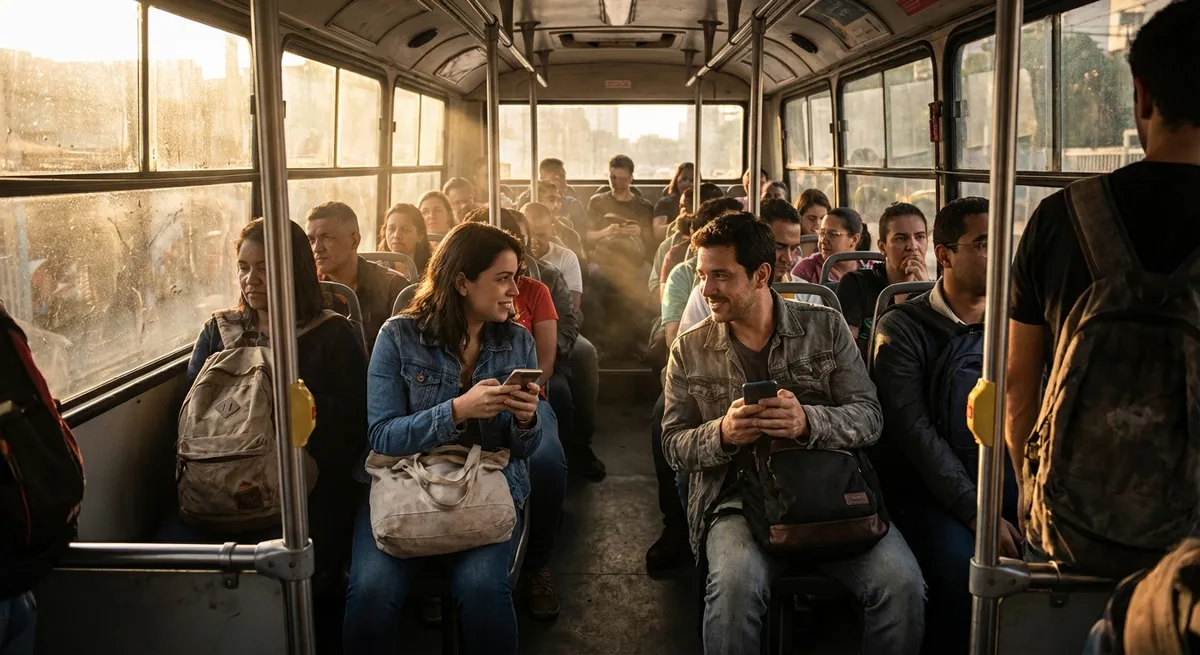
- The “we’re both suffering” smile with someone in a long line
- Saying “Love your jacket, that color’s unreal on you”
- Asking your Uber driver, “Busy day so far?” and actually listening
- Telling a coworker, “That point you made in the meeting really helped”
When I started tracking these, I realized I was already having them—just passively, and usually half-distracted by my phone. Once I became intentional about them, they felt less like background noise and more like small hits of human connection.
Research actually has a name for this: weak ties. In 1973, sociologist Mark Granovetter published “The Strength of Weak Ties,” showing that casual connections can be surprisingly powerful for things like job opportunities and information flow. More recently, psychologist Gillian Sandstrom has studied what she calls “minimal social interactions” with strangers—like small talk with baristas—and found they’re linked to higher happiness and a stronger sense of belonging.
In other words: the small stuff isn’t that small.
What Happened When I Started Doing One Micro-Connection a Day
I didn’t expect this to change much. It felt like a TikTok self-improvement challenge waiting to fizzle out. But here’s what actually changed when I committed to just one deliberate micro-connection each day for 30 days.
1. My social anxiety dialed down a notch
I’ve never been the “walk into a room and instantly vibe with 15 people” type. I overthink. I replay conversations. I remember my weirdest moments from 10 years ago at 2 a.m.
When I tested this micro-connection idea, I realized something: my brain had labeled “talking to people” as a high-risk activity. Every interaction felt like it needed to be impressive, charming, or at least not awkward.
By forcing myself to do tiny, low-stakes interactions, I basically retrained my brain. I told a guy in the grocery store, “That’s the best pasta sauce, you’ve made an excellent life choice.” He laughed. I walked away. That was it. No pressure to keep talking. No “What do you do?” or “Where are you from?” Just a moment.
Over time, my nervous system got the memo: Hey, this isn’t dangerous. People are mostly fine.
There’s some science behind this too. A 2014 study by Sandstrom and Elizabeth Dunn had people either ignore or chat briefly with baristas. Those who chatted reported a better mood and stronger sense of belonging—even though the conversations were tiny. That sense of “I belong here” is exactly what my anxiety had been missing.
2. My phone started losing its grip on my attention
When I was intentional about connecting with people, I noticed I grabbed my phone less in public.
Instead of scrolling while waiting for coffee, I’d look around. I’d notice the teenager training on their first job. I’d hear someone nervously practicing an order in another language. I’d actually see the room I was physically in.
This sounds small, but it snapped me out of that constant “elsewhere” feeling—half on my screen, half in my head, barely in my life.
Neuroscientists talk a lot about dopamine and how social apps hijack our reward system. But micro-connections created a different kind of reward: slower, warmer, a little less addicting and a lot more nourishing. It’s the difference between eating a family dinner and inhaling a bag of chips over the sink.
3. I started feeling less alone… without adding more friends
Here’s the weird part: my number of close friends didn’t change. My group chat didn’t suddenly get more active. I didn’t go to more parties or join five clubs. But my loneliness dropped.
I think it’s because loneliness isn’t just “I don’t have enough people.” It’s also “I don’t feel woven into the social fabric around me.” Micro-connections quietly patched that hole.
I chatted with the older woman who always walks her terrier past my building at 8 a.m. We don’t know each other’s names. But now we’ve built a routine of “Morning!” plus a comment about the weather or the dog’s current level of drama. It takes 8 seconds. But it adds a thread to my mental map of “my people.”
That sense of social fabric is not trivial. The U.S. Surgeon General called loneliness an “epidemic” in 2023 and linked it to increased risks of heart disease, stroke, dementia, and depression. We often think the cure is “find a soulmate friend group.” But sometimes, the first step is just: say one human thing to the person standing 3 feet from you.
How to Start Micro-Connecting (Without Feeling Fake or Awkward)
When I started, I promised myself two things:
- I would never force myself to be someone I’m not.
- I would never cross someone’s boundaries just to “complete the challenge.”
Here’s what actually worked—and what flopped.
Start with what’s already happening
I didn’t go out hunting for interactions; I just upgraded the ones that were already there. For example:
- Cashier interaction upgrade
Old version: “Hi. Yes. Card. Thanks.”
New version: “Long line today, huh? You surviving?”
One cashier told me, “We’re three people down today.” That’s it. But it turned a transaction into a tiny exchange of reality.
- Elevator upgrade
Old version: Stare at my phone and try to look busy.
New version: “I never trust this elevator. I swear it sighs every time we hit floor 3.”
Sometimes people laughed. Sometimes they said nothing. Both outcomes were fine.
I realized that “awkward silence” is often just “two people waiting to see who blinks first.”
Use what I call “one-sentence truth bombs”
I found that the easiest micro-connections had three traits:
- They were about the shared moment
“This playlist is way too dramatic for a grocery store” hits better than “So, where are you from?”
- They were specific
“Nice shoes” is fine. “Those are great running shoes, do they hold up on long walks?” is better.
- They had no hidden agenda
Not networking. Not flirting (unless that’s clear and consensual). Just being human.
Some of my go-to lines:
- “You handled that really kindly. A lot of people wouldn’t have.”
- “The way you just explained that? Super clear. Wish more people did that.”
- “I’ve tried that drink—it’s way better than it looks.”
When they landed, people practically lit up. When they didn’t, nobody died. I just moved on.
When it went wrong (because yeah, sometimes it did)
Not every attempt was a win. A few misfires:
- I commented on a guy’s T-shirt on the subway. He had noise-cancelling headphones on and didn’t hear me. Everyone else did. I basically performed a compliment monologue.
- I tried to joke with a grocery clerk who was clearly having a brutal day. Their one-word response said, “Please, not right now.” I backed off and just gave a quiet “Thank you, really.”
Those reminded me of a crucial rule: consent and context matter more than your goal to be “more social.”
Micro-connections shouldn’t override someone’s need for quiet, safety, or space. The goal isn’t to crack every shell; it’s to gently tap on the ones that are already slightly open.
The Deeper Impact: Why These Tiny Moments Actually Reshape Society
This is where my inner nerd kicked in and I went down a research rabbit hole. It turns out, this stuff is bigger than my mood.
Weak ties make communities more resilient
Granovetter’s research on weak ties showed that they’re essential for how information, opportunities, and help spread. You might not ask your best friend about a job opening—but your friend’s coworker’s roommate? That’s a weak tie.
When I thought about my own life, this made sense. My first real job came through a friend-of-a-friend I only knew from occasional group hangs. I’d never have called them “close,” but that connection changed my entire career path.
When lots of people have lots of weak ties, communities become more:
- Resourceful – People know someone who knows someone who can help.
- Inclusive – Outsiders get pulled in through small, low-pressure contacts.
- Less polarized – You’re more likely to meet people who aren’t exactly like you.
Researchers like Robert Putnam (author of Bowling Alone) have linked declining social trust and community engagement to worse civic health. Micro-connections won’t single-handedly fix that, but they’re like social vitamin D—small, frequent doses that keep the system functioning.
They may nudge our health in ways we don’t feel yet
The Surgeon General’s 2023 advisory pointed to data showing chronic loneliness can increase the risk of early death as much as smoking 15 cigarettes a day. That stat hit me hard.
To be clear: one chat with your barista is not the medical equivalent of quitting smoking. But social connection exists on a spectrum. At one end, deep intimacy. At the other, total isolation. Micro-connections gently tug us away from the isolation side.
There’s early research suggesting that even light social contact can lower stress levels and boost positive emotions, which in turn affect things like inflammation, blood pressure, and sleep quality. It’s not magic; it’s compounding tiny nudges in the right direction.
The Fine Line: When Micro-Connections Aren’t the Answer
As much as I’m a fan of this practice, I want to be honest about its limits.
Micro-connections can’t replace real support
If you’re dealing with serious loneliness, depression, or trauma, you probably need:
- One or two trusted, deeper connections
- Maybe therapy or support groups
- Spaces where you can be fully honest, not just lightly chatty
I’ve had seasons where a kind stranger brightened my day—but what I really needed was a friend who knew my whole messy backstory. Micro-connections can soften the edges of a hard day, but they won’t rewrite the script of a hard life on their own.
They’re not equally accessible to everyone
This part doesn’t get said enough.
Depending on your race, gender, disability, or how you’re perceived, striking up micro-conversations can feel riskier—or simply draining. A Black friend told me she often gets read as “intimidating” if she doesn’t smile and “overly friendly” if she does. A woman I know has had “friendly small talk” misread as flirting way too many times. Disabled and neurodivergent friends have shared that masking through constant small talk can be exhausting.
If this is you, your version of micro-connection might look different:
- A quick wave to a neighbor, not a full comment
- A shared laugh at something obvious, no extra words
- A kind message in a group chat instead of in-person banter
You’re not “doing it wrong” if you adapt it to what feels safe and sustainable.
A Simple, Realistic Way to Try This for One Week
If you’re curious, here’s the exact experiment I used. No toxic positivity, no “new you by Friday” nonsense.
Step 1 – Pick a ridiculously low barFor seven days, aim for one micro-connection per day. Anything counts if:
- It involves another human
- It’s intentional, not autopilot
- It lasts under a minute
Mine were:
- Waiting in line
- In elevators
- With clerks/baristas/drivers
- In the office kitchen
You can steal those or pick your own.
Step 3 – Keep a tiny logI used the Notes app with a simple structure:
- Day
- What I said / what happened
- How I felt after (one word: “lighter,” “meh,” “awkward,” “good”)
Patterns showed up fast. Certain times of day were easier. Certain types of people (other “phone escape artists” like me) were harder to approach. It helped me fine-tune where I spent my social energy.
Step 4 – After a week, ask three questions- Did my mood change even a little?
- Did I feel more “in” my surroundings?
- Did any interaction stick with me?
If the answer to even one of those is yes, you’ve got evidence that these tiny moments aren’t just fluff.
Conclusion
I used to think my social life was defined almost entirely by the big stuff: close friends, deep talks, big gatherings, serious relationships. Those still matter. A lot.
But after deliberately chasing seven-second handshakes with humanity for a month, I can’t unsee what happened: my days feel more three-dimensional. The background characters in my life turned into actual humans. I’m slightly less in my head and slightly more in the world.
You don’t have to become “that chatty person” or pretend you love small talk. You don’t even have to do this every day. But the next time you’re standing two feet from another human while both of you stare at your phones, you might have a tiny superpower you didn’t know was there:
One honest sentence.
Thirty seconds of attention.
A micro-connection that quietly reminds both of you—you’re not actually alone here.
Sources
- U.S. Surgeon General Advisory on the Healing Effects of Social Connection and Community – Overview of data linking social connection and loneliness to physical and mental health outcomes
- “The Strength of Weak Ties” – Mark Granovetter, American Journal of Sociology – Classic sociological paper explaining how casual social connections shape opportunities and information flow
- “Social Interactions and Well-Being: The Surprising Power of Weak Ties” – Gillian Sandstrom & Elizabeth Dunn, Personality and Social Psychology Bulletin – Experimental evidence that brief interactions with strangers (e.g., baristas) can increase happiness and sense of belonging
- Harvard Health Publishing: “Loneliness and Social Isolation — What’s the Difference?” – Explains how different forms of social disconnection affect health
- Robert D. Putnam – “Bowling Alone: America’s Declining Social Capital” (Journal of Democracy) – Discusses the role of social ties (including weak ones) in community and civic life