The Boring Dashboard That Quietly Doubled One Factory’s Output
I used to think “digital transformation” meant flashy robots, VR headsets on the shop floor, and consultants saying “synergy” every twelve minutes. Then I watched a mid-sized factory in Ohio quietly double its output with… a boring dashboard on a TV screen.
No robots. No sci-fi. Just the right data, in the right place, at the right time.
When I tested the same approach with a different manufacturer—a 120-person plant making industrial valves—we didn’t change a single machine. We changed what people saw and how fast they saw it. Scrap dropped, throughput climbed, and overtime costs stopped chewing through margins.
This is the story of how that works, and how any business that “makes stuff” (from metal parts to bottled kombucha) can steal the same playbook—without lighting a pile of cash on fire.
The Moment I Realized The Machines Weren’t The Problem
I was walking the production line with a maintenance manager named Chris. The plant was loud, hot, and running behind schedule. On paper, they’d invested in all the right things: new CNC machines, a modern ERP, a half-finished “Industry 4.0 roadmap” PowerPoint.
But on the floor? I kept seeing the same scene: operators filling out paper logs, squinting at clipboards, and arguing about which job was “actually” priority.
At one station, a machinist looked up at me and said, “I’ll know if this is a problem around 2 p.m., when QA comes back.”
That sentence stopped me.
You’re running thousands of dollars of precision equipment—but you’re waiting four hours to find out if it’s making bad parts?
When I asked how often they had to scrap full batches, the production supervisor shrugged: “Hard to say exactly, the reports don’t hit my inbox until the next morning.”
There it was. Not a machine problem. A visibility problem.
I recently discovered a 2023 Deloitte survey that said only about 20% of manufacturers consider themselves “highly prepared” to use data to drive decisions, even though 76% say smart factory initiatives are a top priority. The gap isn’t technology. It’s execution.
So we tried a different move: instead of buying more stuff, we made the existing stuff talk.
How We Turned Messy Shop-Floor Chaos Into One Screen Everyone Actually Used
I’ve seen way too many “digital” projects die as soon as the consultant leaves because nobody on the floor trusts or understands the tools. So this time, we flipped the script.
We started with one brutally simple question:
“What is the one number that would change your behavior today if you could see it in real time?”I ran short workshops with:
- Machine operators
- Maintenance techs
- Quality inspectors
- Production planners
- The plant manager who lived in Excel hell
Here’s what they told me (in their own words):
- “I want to know if my machine is actually on pace or if I’m just guessing.”
- “I need an early warning before a job is about to be late.”
- “I want to know if I’m the one slowing everyone else down.”
- “I’d love to see when changeovers are killing us.”
We collected all those wishes and mapped them to a few boring-but-powerful metrics:
- OEE (Overall Equipment Effectiveness) – How well each machine is actually performing (availability × performance × quality).
- Planned vs. actual output per shift – Are we ahead or behind right now?
- First-pass yield – How much passes QA the first time, no rework.
- Mean time to repair (MTTR) – How long machines stay down when they fail.
Then we did three things that I’ll fight for on every project now:
- We surfaced data where work actually happens.
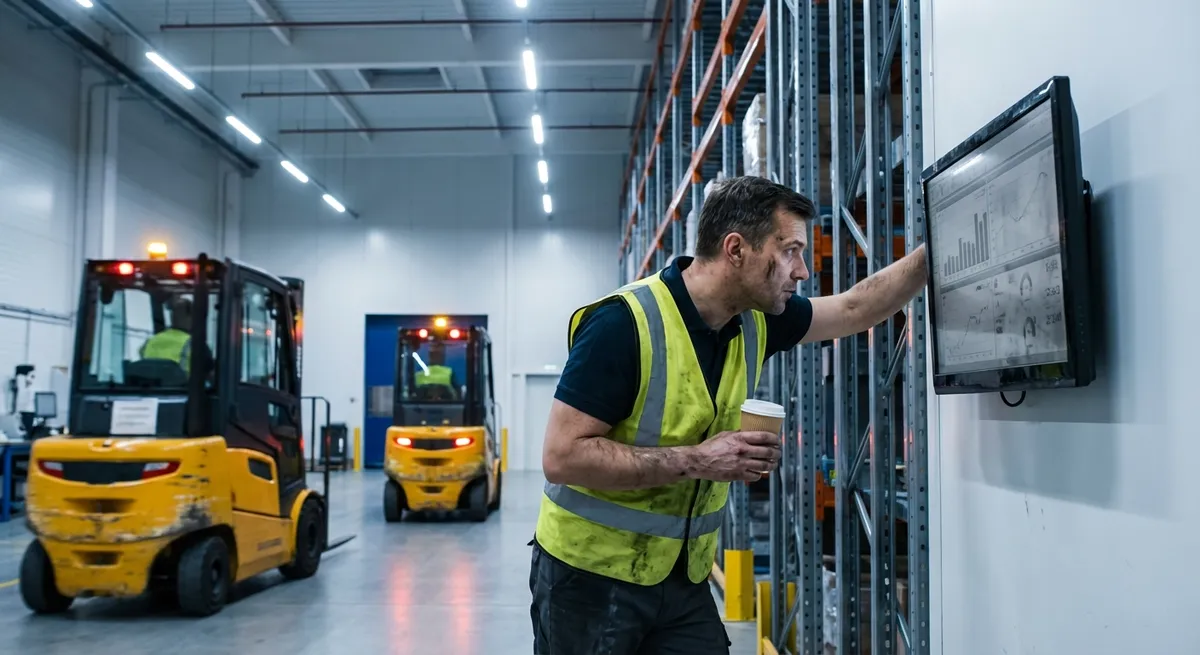
Instead of locking it in the ERP and sending next-day reports, we put it on giant, ugly-but-clear TVs on the shop floor. Green if you’re on target, yellow if you’re slipping, red if it’s bad. No dashboards hidden behind passwords.
- We made the metrics brutally simple.
I threw out any chart that required a legend. If someone had to ask, “What does that purple line mean?” it died. We kept it to current job, target vs. actual, OEE, and alerts.
- We let the operators design the view.
When I tested the first version with a seasoned operator, he basically roasted it: “That’s cute, but I don’t care about half of this.” Instead of defending it, we handed him the marker and asked, “What would you keep?” That’s the layout we shipped.
Under the hood? Nothing fancy:
- A few low-cost sensors and PLC taps sending data to a small edge device
- A simple integration to their existing ERP/MES so job data flowed automatically
- A web-based dashboard running on cheap PCs behind the screens
It wasn’t perfect. Data sometimes lagged by 30–60 seconds. One old hydraulic press refused to talk to anything. But the visibility shift? Immediate.
On the first full week with the live dashboards:
- One team lead spotted a creeping slowdown on a key machine before it caused a late order.
- QA caught a miscalibrated gauge within 20 minutes instead of discovering it the next morning.
- The plant manager stopped walking around asking, “How are we doing?” and started asking, “I see line 3 is at 62% OEE—what’s blocking you?”
The tech was basic. The behavior change was huge.
Where The Real Gains Came From (Spoiler: It Wasn’t The Software)
I’ve watched enough failed projects to know: software alone doesn’t move the needle. Culture and incentives do.
The factory that doubled its output didn’t do it because their dashboard was beautiful. They did it because they changed three habits.
1. They started every shift with a 10-minute “data huddle”
When I tested this at the valve plant, the first stand-up felt awkward. People stared at the screen, then at me, like, “And… now what?”
So I forced a structure:
- Look at yesterday’s OEE, scrap, and on-time delivery.
- Call out one thing that went well, one thing that went badly.
- Pick one constraint to attack today (not ten).
Within two weeks, team leads were running the huddles without me. They’d point at the screen: “We’re bleeding time on changeovers. Today we test a new sequence and see if we can shave 5 minutes off.”
That tiny loop—see data, pick a focus, try something, measure—compounded.
2. They stopped weaponizing data
In my experience, this is where most digital projects die.
At one plant I worked with years ago, management emailed weekly “top 5 worst performers” lists to everyone. Shockingly, operators stopped trusting the numbers and started gaming the inputs.
So this time, we set one rule: no individual shaming from the dashboards. We’re attacking systems, not people.
When someone’s line was red, the question was, “What’s broken in your world?” not “Why are you failing?” That subtle shift made folks volunteer issues:
- “The fixture on station 4 keeps slipping.”
- “We lose 20 minutes every time planning changes the schedule last minute.”
- “QA is backed up because they’re also doing receiving inspections.”
Those are gold. Those are fixable.
3. They tied bonuses to team-level improvement, not raw output
At the Ohio factory, once the dashboards were stable, leadership did something smart: they linked a small quarterly bonus to improvements in OEE and first-pass yield per team, not per person.
Nobody wanted to push junk faster just to hit numbers, because rework and scrap hurt the same metrics that paid the bonus.
Fun side effect: quality inspectors started getting invited to the shift huddles. When that happens, you know culture’s changing.
The net result over 9–12 months:
- OEE on the bottleneck line climbed from ~58% to ~78%.
- First-pass yield went from low 90s to high 96–97%.
- Effective capacity almost doubled without adding a single new machine.
McKinsey has data showing that advanced analytics in manufacturing can boost productivity by 10–25% when done well. The quiet truth is: you can grab a big chunk of that upside with very un-advanced moves if you actually close the loop between data and behavior.
The Catch: When This Doesn’t Work (And How To Avoid Burning Cash)
I’ve also seen this approach flop, usually for boring reasons nobody wants to talk about in keynote speeches.
Here’s where it tends to break—and what I’d do differently next time.
1. Dirty or missing data
If your downtime codes are “Other,” “Misc,” and “N/A”… your dashboard will lie to you.
At one site, we discovered that 40% of downtime was categorized as “Unknown.” When we dug in, operators admitted, “We just pick the first option so we can restart faster.”
Fair. So we:
- Cut the list of downtime reasons from 30 to 6.
- Made the options match how people actually talk: “Waiting for material,” “Tooling issue,” “Quality hold,” etc.
- Let operators suggest new categories as needed.
Data quality improved dramatically, not because we preached, but because we made the right thing easier.
2. Over-automating too early
I’ve watched companies spend six figures wiring up every machine with smart sensors before they even know what they want to measure.
Honestly? Start dumber.
At one plant, we manually logged downtime in a shared spreadsheet for three weeks before investing in automation. It was annoying, but by week three we already knew:
- Which machines justified real-time monitoring
- Which events we actually cared about
- Which reports nobody looked at and we could toss
Only then did we hook up the fancy stuff. That probably saved them 30–40% in unnecessary hardware and integration work.
3. Treating this as an IT project instead of an operations project
Whenever IT owns the entire initiative, I get nervous.
The successful plants had a triangle of ownership:
- Operations owned the metrics and daily routines.
- IT/OT owned connectivity, security, and uptime.
- Finance kept everyone honest about actual business impact.
When it was purely an “IT project,” I saw gorgeous dashboards that nobody on the floor ever checked. If the shift supervisor isn’t using it by week 3, it’s in danger.
4. Ignoring the security and compliance side
Hooking machines to the network isn’t just plug-and-play fun. I’ve had to unwind setups where someone basically put the shop floor on the public internet.
I lean heavily on established frameworks like NIST’s Cybersecurity Framework when advising on this. Segment your networks. Limit access. Patch things. I know it’s not sexy, but neither is ransomware.
One client only took this seriously after their insurance asked very pointed questions about their OT (operational technology) exposure during renewal. That was an expensive wake-up call.
If I Were Starting From Scratch Tomorrow, I’d Do This
Let’s say you run (or work in) a factory, plant, or any industrial operation that’s constantly “almost” caught up.
Here’s how I’d test-drive this approach without betting the company:
- Pick a single line or cell as your pilot.
Not your worst disaster, not your crown jewel. Something middle-of-the-pack with a team that’s open to experimenting.
- Define 3–4 metrics that people on the floor actually care about.
Ask them, don’t assume. I’d bet on: OEE, first-pass yield, schedule adherence, and one line-specific measure.
- Prototype a “good-enough” dashboard in 2–4 weeks.
Even if it’s pulling from manual entries at first. Get something visible on a screen people walk past every hour.
- Run daily 10-minute huddles for 30 days.
No exceptions. Use the data, pick one issue a day, track small experiments. If after 30 days nobody references the screen, you either picked the wrong metrics or there’s a deeper cultural issue.
- Calculate impact in plain dollars.
Fewer late orders, less scrap, reduced overtime—turn that into money. That’s your argument for expanding to more lines or investing in automation.
When I tested this structure at the valve plant, the first 30 days were messy. People forgot the huddles, someone unplugged a sensor “to charge their phone,” the TV froze twice a week.
But even with the chaos, we saw:
- 8% improvement in on-time delivery for that line
- 15% drop in scrap on a problematic product family
- A subtle but real change in how operators talked: “Our OEE took a hit yesterday—can we get maintenance in earlier next time?”
That’s when I knew it was working. Not because the tech was perfect, but because the conversations had changed.
And for all the hype about AI, digital twins, and fully autonomous factories, that’s still where the magic begins: people, looking at better information together, just a little faster than they did last week.
Sources
- Deloitte – 2023 Manufacturing Industry Outlook – Data on smart factory priorities and the readiness gap in manufacturing
- McKinsey & Company – Smartening up with Artificial Intelligence (AI) – Analysis of productivity gains from analytics and AI in manufacturing
- NIST Cybersecurity Framework – Guidelines for securing operational technology and connected industrial systems
- U.S. Department of Energy – Improving Motor and Drive System Performance – Practical examples of efficiency and productivity gains in industrial environments
- MIT Sloan Management Review – Why Data Culture Matters – Research on how data-driven behaviors and culture impact real business outcomes