What Is Laser Cleaning Technology?
If you still picture cleaning in factories as people with wire brushes, sandblasters, and buckets of harsh chemicals… you’re stuck in the 20th century.
Welcome to the era of laser cleaning technology – where rust, paint, oil, and grime are literally vaporized off surfaces using concentrated beams of light.
This isn’t sci‑fi. It’s happening right now in factories, shipyards, automotive plants, and even historic cathedrals. And it’s quietly rewriting the rules of industrial maintenance.
So, What Exactly Is Laser Cleaning?
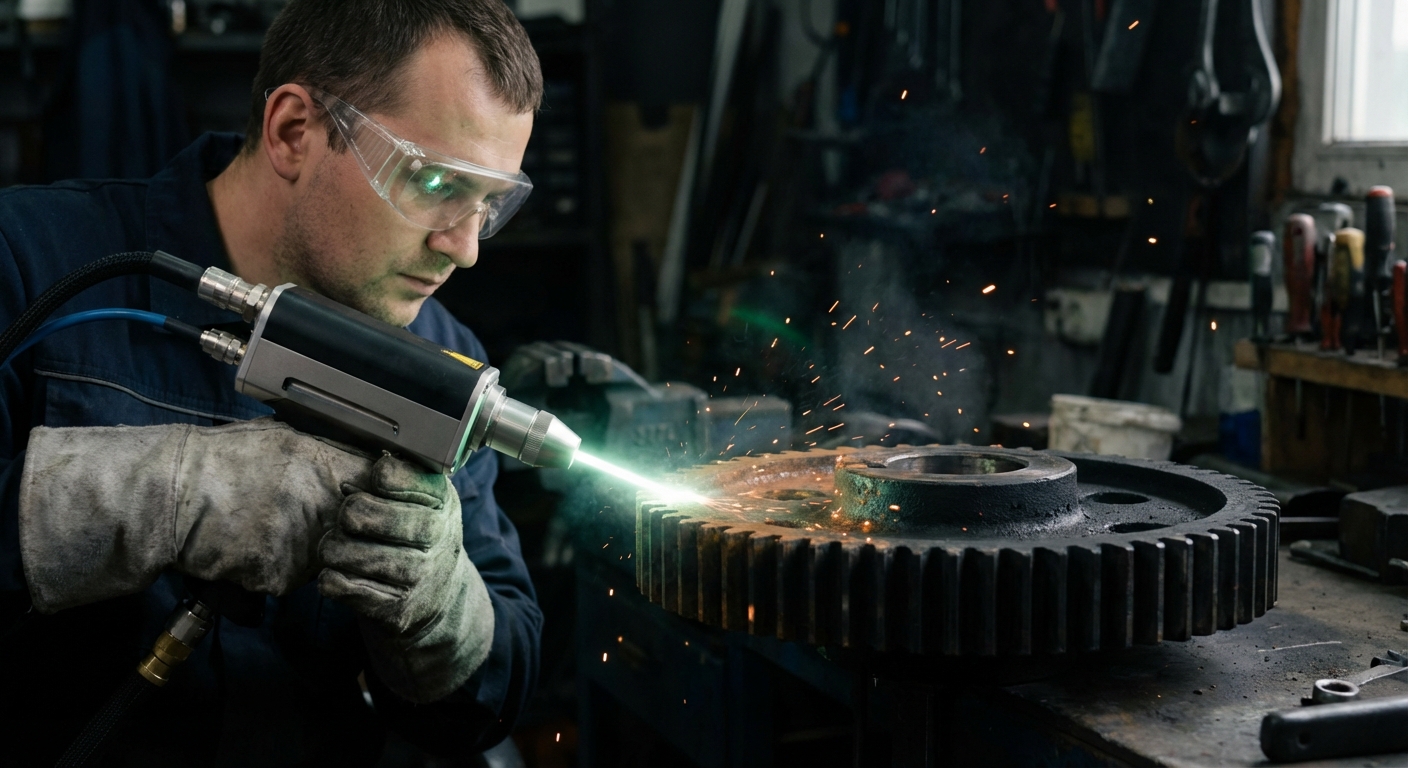
Laser cleaning (also called laser ablation) is a method of removing contaminants from a surface using a highly focused laser beam instead of abrasive blasting or chemical solvents.
Here’s the simple version of the science:
- A laser beam is aimed at the dirty surface.
- The contaminants (rust, paint, oil, coatings, soot, oxide layers, etc.) absorb the laser energy.
- That energy heats and vaporizes or ejects the unwanted layer.
- The base material (metal, stone, etc.) reflects more of the laser, so it’s barely affected.
Result: the gunk is gone, the substrate is left intact, and there’s no sand, no slurry, no toxic baths, and almost no mess.
It’s like giving industrial surfaces a precision laser shower.
Why Businesses Are Suddenly Obsessed With Laser Cleaning
For years, laser cleaning was seen as a niche, ultra‑high‑tech process only for labs and aerospace giants. That changed fast as the tech matured and costs dropped.
Businesses in manufacturing, automotive, energy, and heavy industry are embracing it because it solves some very expensive problems:
- No consumables: No sand, no blasting media, no chemical solvents.
- Minimal waste: Most removed material becomes dust and is easily extracted.
- Non‑contact and precise: No physical abrasion, so base materials last longer.
- Repeatable and automatable: Perfect for robots and production lines.
- Cleaner and safer: Less exposure to chemicals and flying debris.
In a world obsessed with lower downtime, higher safety, and sustainability targets, laser cleaning checks all the boxes.
How Does Laser Cleaning Actually Work? (Without the Physics Degree)
Under the hood, laser cleaning is a mix of optics, physics, and smart controls – but you only need to know a few key ideas:
- Pulsed lasers: Most systems use ultra‑short laser pulses. These deliver a lot of energy in a tiny fraction of a second, hitting the contamination hard while limiting heat transfer to the base material.
- Different absorption: Rust, paint, and oils tend to absorb laser light differently than steel or stone. That difference is what makes selective cleaning possible.
- Micro‑explosions: The contaminant layer rapidly heats, expands, and partially vaporizes. Tiny shockwaves help lift and eject material.
- Parameters you can tune: Power, pulse duration, repetition rate, and scanning speed are adjusted depending on whether you’re removing delicate soot from a statue or thick corrosion from a ship hull.
From an operator’s perspective? It’s often as simple as adjusting settings on a touchscreen and moving a handheld laser head like a high‑tech pressure washer.
Where Is Laser Cleaning Used in Industry?
Laser cleaning is sneaking into more sectors every year. Some of the hottest use cases:
1. Automotive & Manufacturing
- Weld preparation: Removing oxides, oil, and coatings from metal parts before welding for stronger, more consistent welds.
- Paint & coating removal: Stripping paint or coatings from parts, frames, or molds without damaging the base material.
- Mold and tool cleaning: Cleaning plastic, rubber, or tire molds without disassembly or abrasive blasting.
2. Aerospace & Defense
- Surface prep for bonding: Ensuring ultra‑clean surfaces for adhesives and coatings.
- Coating removal: Stripping tough protective layers from high‑value components safely.
3. Energy & Heavy Industry
- Rust and corrosion removal on pipelines, turbines, ship hulls, and structural steel.
- Nuclear decontamination: Laser systems can remove contaminated surface layers with very controlled waste.
4. Restoration & Cultural Heritage
- Cleaning historic stone, statues, and monuments without dissolving detail or damaging fragile surfaces.
The common thread: anywhere dirt, corrosion, or coatings cost time and money, laser cleaning is a serious contender.
5 Amazing Laser Cleaning Facts & Stories People Can’t Stop Sharing
1. Lasers Are Restoring 800‑Year‑Old Cathedrals
In Europe, laser systems have been used to clean blackened stone on ancient cathedrals and sculptures. Pollution and soot that built up over centuries are removed millimeter by millimeter, revealing original stonework that hasn’t been visible for generations.
Conventional methods risked eroding the stone. Lasers, tuned carefully, remove the pollution while preserving delicate chisel marks from medieval craftsmen. Yes – 21st‑century lasers are literally partnering with 13th‑century stonemasons.
2. Some Plants Paid Off Their Laser Cleaner in Under a Year
Industrial blasting is deceptively expensive: media purchase, storage, disposal, PPE, cleanup, downtime, and regulatory headaches add up. Several manufacturers report that swapping to laser cleaning cut their cleaning‑related costs so much that the system paid for itself in less than 12 months.
After that, the math gets wild: each avoided drum of chemical waste or ton of blasting media is pure savings.
3. Rust Literally Vanishes in Viral Laser Cleaning Videos
If you’ve seen those oddly satisfying clips where a rusty metal plate is passed under a laser beam and instantly turns shiny and clean – that’s this tech.
What blows people’s minds:
- No grinding
- No sand clouds
- No scraping sounds
- Just a torch‑like beam sweeping over metal and whoosh – clean, bare surface.
Those videos aren’t CGI; they’re portable laser cleaning units that are now rented and sold worldwide.
4. In Some Cases, It’s Gentler Than a Toothbrush
This sounds impossible, but at carefully controlled energy levels, laser cleaning can be more delicate than mechanical brushing.
Museums and conservators have used low‑power laser systems to remove soot and grime from fragile frescoes, statues, and even ancient metal artifacts where any abrasive contact would be destructive.
When tuned right, the laser interacts primarily with the dirt – not the history beneath it.
5. Robots + Lasers = Self‑Cleaning Production Lines
Because lasers can be precisely controlled and require no consumables, they’re ideal for automation.
Some factories already use robotic arms equipped with laser heads to:
- Clean weld seams before and after welding
- Prepare surfaces between coating stages
- Maintain molds and dies on the line without disassembly
Imagine a future where entire production lines clean themselves between runs – no shutdowns, no manual scrubbing, just smart robots and beams of light.
Is Laser Cleaning Always the Best Option?
Not always – and that’s important.
Situations where traditional methods may still win:
- Very low‑value parts where capex must be near zero
- Surfaces where contaminants are extremely thick and uneven
- Environments where operators can’t be trained or protected for laser use
However, as systems get cheaper, more portable, and easier to use, laser cleaning keeps eating into the territory of sandblasting, grinding, and chemical stripping.
For many businesses, the tipping point is reached when they compare:
- Lifetime cost of abrasives, chemicals, waste disposal, rework, and downtime
- One‑time cost of a laser plus routine maintenance
That’s when light starts looking very attractive.
The Future: When Cleaning Becomes a High‑Tech Superpower
Laser cleaning technology sits at the crossroads of three powerful trends:
- Automation & robotics – easy to integrate into cells and production lines.
- Sustainability – less waste, fewer chemicals, lower environmental impact.
- Precision manufacturing – tighter tolerances demand cleaner surfaces.
For business and industrial leaders, it’s not just a cool gadget – it’s a strategic tool:
- Cut downtime
- Reduce consumable and disposal costs
- Improve worker safety
- Hit ESG and sustainability targets
- Protect high‑value equipment and assets
So the next time someone asks, “What is laser cleaning technology?”, you can tell them:
It’s the moment industrial cleaning stopped being messy, noisy, and toxic – and became a clean, precise, high‑tech superpower powered by light.
And if your competitors are already using it? They’re not just cleaning faster. They’re operating in a different decade.