I Tried Letting My Car Drive Itself: What Really Happens With Modern Driver Assist
I used to roll my eyes at cars that practically needed a software update more than an oil change. Then I spent a week daily-driving a newer car loaded with adaptive cruise control, lane-keeping assist, and automated parking. I went in skeptical…and I came out realizing we’re way closer to semi‑self‑driving than most people think—just not in the way the ads make it look.
If you’ve ever wondered, “Can I actually trust this thing to help me drive?” or “Is this just expensive tech that beeps at me?”, I’ve been there. Here’s what really happens when you hand some of the work over to your car—and what no one tells you until you’re white‑knuckling an ‘almost’ self‑driving highway merge.
What Driver Assist Features Actually Do (vs. What People Think They Do)
When I first sat in a car with driver assist, the salesperson casually said, “It basically drives itself on the highway.” That line should come with a massive asterisk.
These systems fall under what the industry calls Advanced Driver Assistance Systems (ADAS). On the official SAE automation scale, most of what’s sold today is Level 2: the car can control steering and speed at the same time, but you’re still 100% responsible. The National Highway Traffic Safety Administration (NHTSA) is pretty blunt about this: if you crash, you don’t get to blame the robot.
In my experience, the tech breaks down into a few big buckets:
- Adaptive Cruise Control (ACC): You set a speed, the car speeds up and slows down to follow traffic. Great on highways, mediocre in aggressive city traffic.
- Lane Keep Assist / Lane Centering: Uses cameras to watch lane lines. The car nudges or steers to keep you centered. Brilliant on clear highways; confused by faded paint or construction zones.
- Automatic Emergency Braking (AEB): If you’re about to rear-end someone and don’t react, it can slam the brakes. I’ve had it trigger once when a car cut in hard—heart‑stopping, but it worked.
- Blind Spot Monitoring and Rear Cross-Traffic Alert: Tiny lights in your mirrors + warning chimes when you try to lane change into another car, or when backing out of a tight parking spot.
On paper, all of this sounds like sci‑fi. In real life, it feels less like “self-driving car” and more like driving with a very alert but slightly anxious co‑pilot who occasionally panics and grabs the wheel.
What Happened When I Let Adaptive Cruise and Lane Keeping Take Over
The first long drive I tested this on was a 3‑hour evening highway run. I was tired, it was drizzling, and I figured, “Okay car, let’s see what you’ve got.”
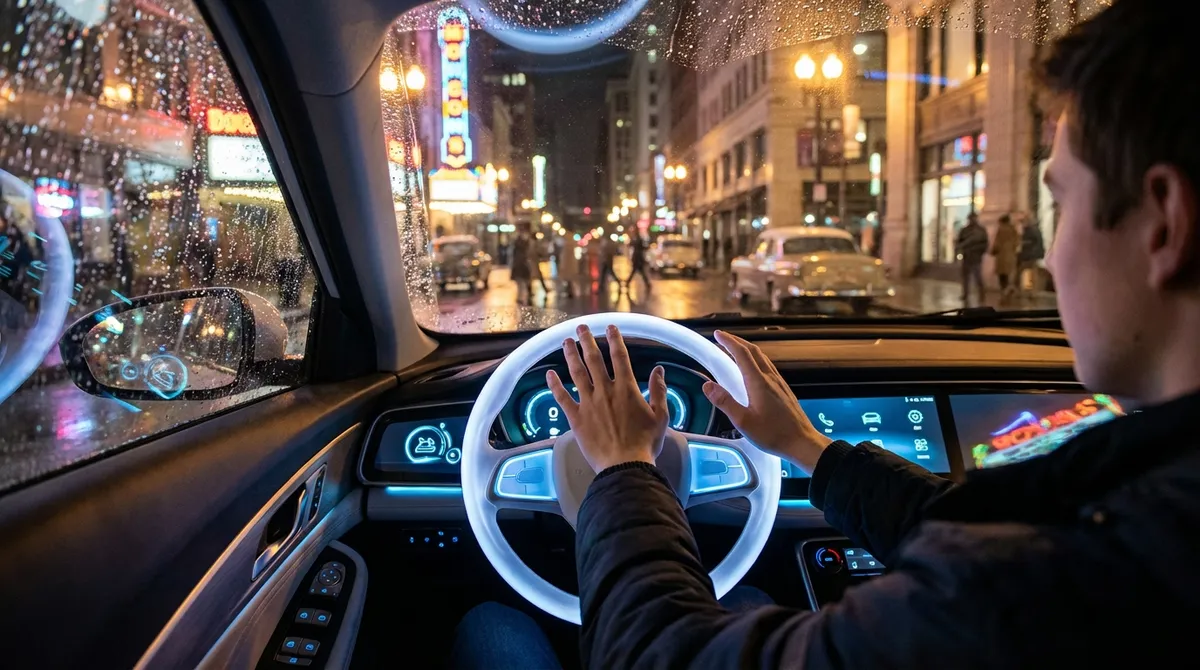
I turned on adaptive cruise control at 70 mph and lane centering. A little steering wheel icon lit up, and suddenly the wheel had a life of its own—subtle corrections, tiny adjustments to stay dead center in the lane. At first, it was frankly creepy. Then… it became strangely relaxing.
Here’s what stood out after a week of mixed driving:
- Fatigue dropped—mentally and physically. Normally, I’m micro-adjusting speed, constantly checking following distance, and tensing up in stop‑and‑go traffic. With ACC handling the throttle and brake, my legs and right foot got a break. I still had to watch everything, but it felt like my brain had 20–30% more bandwidth.
- Traffic jams became way less miserable. In bumper‑to‑bumper traffic, the car would crawl, stop, and restart on its own. When I tested it in a brutal rush-hour snarl, I barely touched the pedals for 25 minutes. I was still steering, still paying attention, but the usual “my ankle is dying” feeling just… didn’t happen.
- Lane centering was amazing… until it wasn’t. On a freshly paved highway with bright lane markings, the system held the car like it was on rails. But the moment the lines got faint, or a lane ended near an off‑ramp, I could feel the system hesitate. A couple of times, the steering gently ping-ponged between the lane markers instead of holding a perfect center. I learned to treat it like power steering with opinions, not an autopilot.
- The car sometimes braked harder than I would. When a car cut in front of me a bit too closely, my ACC tightened the gap by braking more aggressively than I would’ve. It wasn’t unsafe, but it felt jarring. AEB and ACC are tuned to err on the cautious side, and you can feel it.
After a few days, I trusted the systems more—but never fully. My hands stayed on the wheel, and my thumb hovered near the cancel button on the steering wheel like it was a safety switch.
The Weird Moments Nobody Warns You About
Driver assist tech is great… right up until it isn’t. These are the moments that made me realize how far we still have to go.
1. The “Ghost Brake” IncidentOn a sunny afternoon, no traffic, clear lane markings—perfect conditions. Suddenly, the car taps the brakes for half a second. No one in front of me. It felt like it “saw” something that didn’t exist.
This is a known quirk with some systems: false positives, sometimes triggered by shadows, overhead signs, or vehicles in adjacent lanes. I dug into NHTSA reports later and found multiple investigations into similar behavior in various models. It’s not common, but when it happens, it spikes your adrenaline.
2. Rain, Glare, and Dirty CamerasOne night, driving in a steady rain, my lane-keeping system just… gave up. A warning popped up: “Lane Assist Unavailable – Limited Visibility.” Suddenly, it was all me again.
I also had a moment during low sun when glare washed out the lane lines, and the car kept drifting toward the right line until I corrected it. Anything that blinds the front camera—mud, salt, sun, heavy rain—can knock the system offline. If you assume it’s always watching, that’s a problem.
3. Construction Zones Are ChaosThe worst performance I saw? A highway construction zone with temporary orange lines, cones, and weirdly shifted lanes. My lane centering tried to decide whether to follow the old white lines or the new orange ones. It wobbled just enough that I turned it off entirely and drove the old-fashioned way.
Most automakers quietly acknowledge this: complex, changing environments confuse the algorithms. That’s part of why regulators hammer home that these are assist features, not self-driving.
Where These Features Genuinely Shine
When used the right way, modern driver assist can make driving safer and just… less exhausting. I started noticing three big benefits.
Highway Cruising Becomes Less of a ChoreOn a 2‑hour nighttime highway drive, ACC + lane centering turned what usually feels like a grind into something calmer. I was more relaxed but still engaged. No zoning out, no sudden “whoa, how did I get here?” moments. I found myself checking mirrors and scanning far ahead more, because my brain wasn’t busy modulating the gas pedal every second.
Stop‑and‑Go Hell Is Way More BearableIn dense city traffic and rush hour jams, ACC is a game changer. Instead of constantly feathering the brake and creeping forward, the car handles the creeping. I still steered and watched like a hawk, but the stress felt dialed down. I was less irritable when I finally got home—which, frankly, is a safety feature in itself.
Emergency Braking Is a Real LifesaverThe one time my AEB triggered, I was changing lanes and the car ahead of the new lane braked harder than I expected. Before I fully reacted, I felt the system jump in—hard, controlled braking. We stopped with room to spare.
Crash data backs this up: IIHS has found that vehicles with front crash prevention (AEB + forward collision warnings) have significantly lower rear‑end crash rates than those without. It can’t defy physics, but when milliseconds matter, having extra “eyes” pays off.
The Downsides You Only Notice After Living With It
After the honeymoon period, a few annoyances—and potential safety concerns—started showing up.
You Can Get Too ComfortableThere were moments on long drives where I caught myself letting my attention soften more than I liked. The car is doing so much that your brain wants to treat it like a plane on autopilot. That’s the dangerous part, because unlike a plane’s autopilot, these systems are nowhere near capable of handling all scenarios.
NHTSA has specifically warned about “automation complacency”—people over-trusting Level 2 systems and reacting slower when things go wrong. I could feel that tendency creeping in during boring stretches of road.
Not All Systems Are EqualWhen I hopped between brands, the differences were huge:
- One car’s lane centering held the line smoothly.
- Another car constantly corrected in tiny jerks.
- Some cars nag you every 10–15 seconds to touch the wheel; others are laxer.
The marketing names—“Pilot Assist,” “Co‑Pilot360,” “Super Cruise,” etc.—can make everything sound similar, but the tuning, sensors, and software are wildly different. If you’re shopping, you really do have to test-drive the tech itself, not just the engine and seats.
Buzzer Fatigue Is RealBetween lane departure warnings, blind spot alerts, speed limit warnings, and parking beeps, the car can start to feel like a judgmental driving instructor. On a bad day, it’s tempting to just turn half of it off, which… defeats the purpose.
I ended up customizing the settings: softer lane departure warning, blind spot kept on, rear cross-traffic alerts loud, and speed warnings off. Once I tuned it to my tolerance, it felt less naggy and more genuinely helpful.
How to Actually Use These Features Safely (From Someone Who Was Skeptical)
After a week of trial, error, and a couple of “nope, I’m taking over now” moments, I settled on a way of using driver assist that felt both safer and less stressful.
Here’s what worked best for me:
1. Treat It Like a Co‑Pilot, Not a ChauffeurI think of ACC and lane centering as an extra set of hands, not a replacement for mine. My hands stay on the wheel. My eyes stay moving—mirrors, road ahead, side traffic. The tech handles the mechanical grunt work; I handle the judgment calls.
2. Learn the Limits Before You Rely on ItI forced myself to read the manual section on driver assist (yes, those 20 pages no one touches). That’s where I found out:
- The minimum speed where lane centering activates
- Situations where the camera may lose lane visibility
- How hard AEB can brake and when it won’t intervene
It’s not exciting reading, but after seeing how often conditions confused the car, I was glad I knew its blind spots.
3. Practice Taking Over SmoothlyI experimented on empty roads: turning systems on and off, using the cancel button, and simply overpowering the steering assist with my own hands. That way, when I hit that messy construction zone and had to instantly bail on lane centering, it felt natural, not panicked.
4. Keep the Sensors CleanAfter a rainy, salty winter day, my front camera view (visible in the settings) looked like a foggy lens. Lane assist was flaky until I wiped the front camera area and radar sensor. It’s low‑tech, but a clean windshield and sensor covers make a big difference.
Are “Self-Driving” Cars Actually Close… or Is This Just a Tease?
After personally living with Level 2 driver assist for a while, my view shifted from “this is overhyped nonsense” to “this is impressive—but it’s not what people think it is.”
On one hand, what we already have is incredible:
- Cars can maintain speed, follow traffic, and stay centered in a lane on their own—under good conditions.
- Emergency systems are measurably reducing certain types of crashes.
- Long highway drives are genuinely less draining when the car helps manage the boring, repetitive parts.
On the other hand, those viral videos of people napping in Teslas or reading in the driver’s seat? That’s not the tech—it’s misuse. Regulators, engineers, and safety experts are all aligned on this: you are still the driver.
The gap between “assisted driving” and “you can ignore the road” is massive. Rain, snow, weird road markings, pedestrians, cyclists, unpredictable human drivers—those edge cases are where current systems tap out.
From my time behind the wheel, I’d sum it up like this:
- Used correctly, modern driver assist absolutely makes driving safer and less stressful.
- Used as “self-driving,” it’s a trap.
If you’re car shopping or just figuring out the tech in your current ride, the best thing you can do is this: learn what your system actually does, test it in low‑risk situations, and keep your brain firmly in the driver’s seat—even when the car’s doing half the work.
Conclusion
Spending serious time with driver assist features completely changed how I see modern cars. I started off treating them like gimmicks and ended up genuinely missing adaptive cruise control the next time I drove an older car. The tech isn’t magic, and it’s far from perfect—but when you respect its limits and stay engaged, it feels like having a calm, never‑tired co‑driver backing you up.
If you’ve been side‑eyeing those little steering wheel icons and “assist” buttons on your dash, it might be worth giving them an honest try. Just remember: the car can help you drive—but it’s not ready to take your job yet.
Sources
- National Highway Traffic Safety Administration – Automated Vehicles for Safety – Explains the different automation levels and the role of driver assistance systems
- SAE International – Taxonomy and Definitions for Terms Related to Driving Automation Systems – Industry standard that defines Levels 0–5 of driving automation
- Insurance Institute for Highway Safety (IIHS) – Front Crash Prevention – Data and analysis on how automatic emergency braking and related systems reduce crashes
- Consumer Reports – Guide to Advanced Driver Assistance Systems – Independent testing and comparison of various automaker driver assistance features
- AAA Foundation for Traffic Safety – Active Driving Assistance Systems Study – Research on how current systems perform in real-world driving and their limitations