I Ate Like a “Blue Zone” Local for 14 Days — Here’s What Actually Changed
I kept seeing “Blue Zone” recipes all over my feed — beans, leafy greens, olive oil, repeat — and finally snapped. Instead of just saving another chickpea bowl to a folder I’d never open again, I decided to go all in. For two weeks, I ate only meals inspired by Blue Zone regions (those places where people routinely live into their 90s and 100s) and tracked what happened to my energy, cravings, and mood… and also whether I’d get bored out of my mind.
Spoiler: I didn’t. And some things changed way faster than I expected.
What “Blue Zone Eating” Actually Means (Beyond Pretty Bowls on Instagram)
Before I started, “Blue Zone diet” sounded like another vague wellness buzzword. When I dug in, I realized it’s not a branded diet at all — it’s basically years of food anthropology and epidemiology wrapped into a lifestyle.
Blue Zones are regions identified by researcher Dan Buettner and National Geographic where people live significantly longer and healthier lives: places like Okinawa (Japan), Sardinia (Italy), Ikaria (Greece), Nicoya (Costa Rica), and Loma Linda (California). Researchers looked at what these communities actually eat day-to-day, not what looks good on a Pinterest board.
Here’s what I found when I broke it down for myself:
- Around 90–95% of calories come from plants: vegetables, fruits, whole grains, beans, lentils, nuts.
- Beans are the quiet main character — in some zones, people eat at least 1 cup per day.
- Animal products show up, but they’re more like a supporting cameo: small portions of fish, eggs, or cheese a few times a week.
- Sugar and ultra-processed foods exist, but they’re not daily habits.
- Alcohol, where present, is usually wine, in small amounts, with food and people — not solo, stress-chugged at midnight.
I set my own rules for the 14-day experiment:
- Eat Blue Zone-style at least 2 out of 3 meals per day (usually all 3).
- Base most meals on beans, whole grains, and vegetables.
- Limit meat to no more than 2 small servings a week, mainly fish.
- No ultra-processed snacks as “meals” — chips could be a side, not a stand-alone lunch.
- Keep coffee (for the sake of everyone around me), but dial down sugary drinks.
I wasn’t tracking macros or counting calories. I just wanted to see: What happens if I eat roughly like a long-living person for two weeks?
What I Actually Ate (Yes, There Were Carbs, Calm Down)
I thought this would be two weeks of sad salads and depression lentils. It wasn’t. The food was absurdly satisfying — but only after I stopped trying to force it into “diet” mode and let it be kind of rustic and messy.
Here’s a snapshot of how the days looked:
Breakfasts that didn’t feel like cardboard:Most mornings I rotated through:
- Oatmeal with walnuts and fruit: Rolled oats cooked in water with cinnamon, topped with sliced banana, frozen berries, and a handful of walnuts. I added a drizzle of honey on heavy workout days.
- Savory miso oats (inspired by Okinawa): Oats cooked in vegetable broth, stirred with miso paste and green onions, topped with sautéed mushrooms and sesame seeds. This felt like a hug in a bowl.
- Whole-grain toast with olive oil and tomato: Basically Spanish pan con tomate but with extra olive oil and some olives on the side.
When I tested higher-protein breakfasts vs carb-heavy ones, the bean or nut-heavy options held me over noticeably longer. Oatmeal with walnuts kept me full until lunch; toast alone had me hunting snacks at 10:45 a.m.
Lunches where beans finally had their main-character moment:I leaned hard into what the research called out: beans, beans, beans.
Meals looked like:
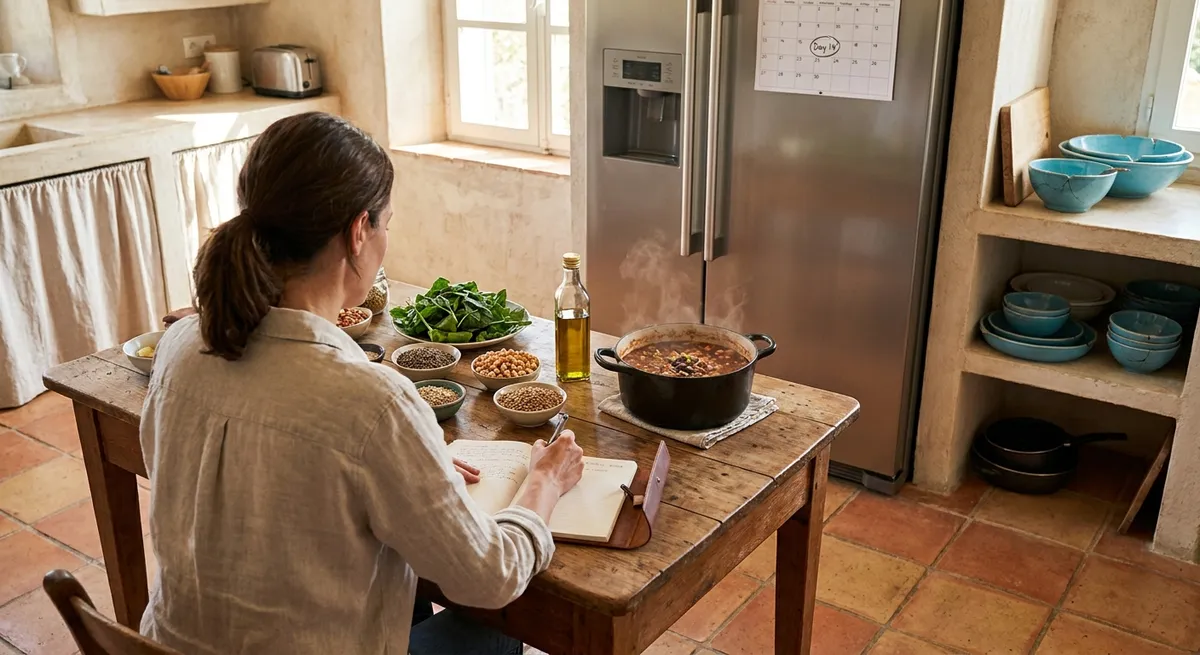
- Sardinian-style minestrone: White beans, chickpeas, carrots, celery, onion, tomatoes, cabbage, and a bit of barley, finished with olive oil. I made a huge pot on Sunday and basically lived off it.
- Chickpea “power bowl”: Chickpeas, roasted sweet potatoes, shredded cabbage, cucumbers, and tahini-lemon dressing over brown rice.
- Lentil and walnut “meat” sauce: Lentils simmered with tomatoes, garlic, and herbs over whole-grain pasta, topped with a tiny sprinkle of Parmesan.
I noticed that whenever lunch had beans + whole grains + some fat (olive oil, nuts, avocado), my 3 p.m. “I need sugar or I’ll die” slump dialed way down.
Dinners that didn’t feel like punishment:At night I tried to theme meals around actual Blue Zone regions:
- Okinawa-inspired bowl: Sweet potato, tofu, cabbage, carrots, green onions, and seaweed with a soy-ginger dressing over barley.
- Ikaria-style beans and greens: Giant beans (I used cannellini) simmered in tomato with onions, garlic, and lots of herbs, piled over wild-ish greens (I used kale and dandelion greens when I could find them).
- Simple fish + veg nights: A small piece of salmon or sardines with roasted vegetables, plus a side of white beans with lemon and parsley.
Twice over the two weeks I had a small glass of red wine with dinner and friends, Blue Zone-style, which I will not pretend was purely for health reasons.
Snacks were very “grandparent who gardens”:
- A handful of nuts.
- Fruit with peanut butter.
- Leftover soup.
- Random cold beans from the fridge (which, to my surprise, I started craving).
What Changed in 14 Days (Energy, Cravings, and Weird Side Effects)
Here’s what I actually noticed — and where it didn’t live up to the hype.
1. My energy got… boring in the best way
By day 4 or 5, I realized my energy curve wasn’t doing that violent roller coaster thing anymore. It was more like a steady hill.
When I tracked it in my notes app:
- Pre-experiment, I usually had a post-lunch slump around 2–3 p.m., especially after takeout or heavy sandwiches.
- During the Blue Zone experiment, the slump shrank to “I could nap, but I don’t need to.”
I’m not saying beans cured my life, but there’s good science showing why this pattern makes sense. Legumes and whole grains are high in fiber and have a low glycemic index, which slows down how quickly your blood sugar spikes and crashes. That steadier blood sugar can mean more stable energy across the day.
2. My cravings shifted — not disappeared, but changed shape
First three days: I wanted ultra-processed snacks out of sheer habit. It wasn’t even hunger — just “this is the part where I eat something crunchy and salty.”
By the second week:
- I still wanted dessert some nights, but a square or two of dark chocolate felt like enough instead of a full sugar raid.
- I started craving textures — creamy beans, crunchy greens, chewy grains — in a way that made candy feel a little flat.
To be clear: I did not transcend into some monk-like state where I don’t care about fries. But I did notice that after eating high-fiber, higher-protein meals, my sweet tooth felt more like a nudge than a takeover.
3. My digestion had… opinions
Let’s be honest: massively ramping up beans and fiber in a short timeframe will 100% engage your digestive system.
- Days 1–3: Some bloating, extra gas, and a bit of “wow, okay, that’s new.”
- Days 4–7: My body seemed to catch up. Things normalized, and I felt lighter after meals instead of weighed down.
From a gut perspective, increasing fiber and resistant starch (lots of beans, cooled potatoes, whole grains) feeds beneficial gut bacteria. The catch: if you go from low-fiber to high-fiber overnight, your gut microbiome basically needs time to re-balance. I probably could’ve eased in a little slower.
4. Sleep got slightly better — but not magically perfect
I wasn’t expecting sleep to change, but it did, a little:
- I fell asleep faster on nights when dinner was earlier, lighter, and mostly plants.
- On the one night I overdid it with pasta and wine, I slept like I’d swallowed a brick.
Some Blue Zone communities eat their heaviest meal earlier in the day and keep dinner smaller. On days when I accidentally did this (big lunch, lighter dinner), I noticed less heartburn and fewer middle-of-the-night wakeups.
Sleep is obviously influenced by a hundred things — stress, screens, temperature — but food timing and heaviness clearly played some role for me.
5. My relationship with “healthy eating” got less neurotic
This was maybe the biggest surprise.
I’ve done the high-protein thing, the low-carb thing, the “only eat ingredients your great-grandmother would recognize” phase (which, by the way, eliminates tofu, so I’m out). Most of them made me think about numbers and restrictions.
This experiment felt different because the core question in my head shifted from:
> “Is this low-cal / low-carb / low-whatever enough?”
to
> “Does this look like something a 95-year-old Sardinian grandma would casually eat?”
It sounds silly, but that simple mental reframe made my choices feel more flexible and human instead of rule-obsessed. I wasn’t chasing perfection. I was just trying to nudge my meals toward “village food” rather than “factory food.”
The Pros, the Cons, and Who This Might Actually Work For
This wasn’t a miracle makeover. No dramatic “I lost 20 pounds in 2 weeks” nonsense. But there were clear upsides — and some real trade-offs.
The upsides I’d happily keep
1. Ridiculously easy meal planningOnce I got the hang of it, meals became plug-and-play:
- Pick a bean.
- Pick a grain.
- Pick 2–3 vegetables.
- Add olive oil, herbs, and something tangy (lemon, vinegar, miso).
That one formula quietly killed a lot of “what should I eat?” decision fatigue.
2. Groceries were cheaperWhen I looked at receipts:
- Dried beans, lentils, rice, oats, and seasonal produce were way cheaper than my usual mix of convenience foods and animal protein.
- Even when I bought higher-quality olive oil and nuts, my overall food cost for the two weeks went down.
Studies have actually shown that healthy dietary patterns don’t have to be more expensive when they lean heavily on staples like beans and whole grains — which lined up with my receipt reality.
3. It’s flexible enough to fit different cultures and preferencesI liked that this wasn’t a one-flavor, one-culture template. You can do Blue Zone-ish meals that feel:
- Mediterranean (tomatoes, olives, beans, pasta, greens)
- Japanese/Okinawan-inspired (tofu, sweet potato, seaweed, rice, miso)
- Latin American (black beans, corn, rice, plantains, avocado)
- Middle Eastern (chickpeas, lentils, flatbread, tahini, herbs)
You’re basically just upgrading traditional food, not inventing something strange to your taste buds.
The downsides and real challenges
1. Social eating got a little awkwardEating out was the hardest part. Options were often:
- Heavy meat dishes
- Cheese-heavy plates
- Or “sad side salad and fries”
I ended up doing the “flex” version — choosing the most plant-forward thing on the menu and not panicking if it wasn’t perfectly Blue Zone-y. But if you’re very strict, this would get old fast.
2. It takes a bit of front-loaded prepBeans and whole grains are cheap and filling, but they’re not exactly 90-second microwave meals unless you plan ahead.
When I didn’t batch-cook:
- I defaulted back to toast and random snacks.
- I got annoyed at how long brown rice takes when I’m already hungry.
The days I did best were the ones when I had one big pot of beans and one big pot of grains ready to go.
3. It’s not a fast-fix “transformation” dietIf your goal is extremely rapid fat loss or a bodybuilder-level physique, this pattern might feel too slow or too carb-friendly for your timeline.
Blue Zone-style eating shines more as a long game: lower chronic disease risk, better gut health, more stable energy. Those benefits are very real but not as visually dramatic as some program that promises visible abs in 6 weeks.
How to Try a Low-Stress Blue Zone Week (Without Moving to a Greek Island)
If you’re curious but not ready to go all-in for two weeks, here’s what, in my experience, gives the biggest payoff with the least pain.
1. Make beans non-negotiable once a dayDon’t overthink it. Just add beans somewhere, daily:
- Toss a half cup of chickpeas into a salad.
- Add black beans to your eggs or tofu.
- Keep a container of cooked lentils in the fridge to sprinkle on everything.
Most Blue Zone populations eat beans daily, and there’s solid evidence linking higher legume intake to lower mortality and better heart health.
2. Swap just one meat-heavy meal for a plant-heavy oneYou don’t have to quit meat. Simply choose one meal you usually anchor on meat and flip the script:
- Taco night → black bean and veggie tacos with cheese as a topping, not the base.
- Pasta night → lentil Bolognese with a little Parmesan instead of ground beef as the main mass.
- Burger night → bean burger with avocado and a side of roasted potatoes.
It feels less like sacrifice and more like “trying a different recipe.”
3. Choose “grandma carbs,” not “factory carbs”Carbs aren’t the enemy here — the type is. Aim for what I started calling “grandma carbs”:
- Oats instead of sugary cereal
- Brown rice or barley instead of instant white rice all the time
- Potatoes with the skin, roasted in olive oil, instead of fries from a bag
Fiber and minimally processed carbs were the backbone of pretty much every region I looked at.
4. Add one “pleasure ritual” that isn’t foodThis sounds unrelated, but it mattered. In Blue Zones, food is tied to connection — slow meals, family, neighbors — not just solo mindless eating while doom-scrolling.
I tried a tiny version of that:
- Phone away for at least one meal a day
- 10–15 minutes of sitting outside after dinner
- A short walk instead of dessert some nights (not always, I’m not a saint)
Weirdly, this made it easier to stop eating when I was full, because the meal had a start and an end instead of blending into snack-land.
The Thing I Didn’t Expect to Feel: Less “All or Nothing”
By the end of the 14 days, I didn’t want to stop — not because I was suddenly obsessed with longevity charts, but because I felt… calmer around food.
Blue Zone-style eating didn’t ask me to be perfect. It just nudged me to do more of what clearly works for actual long-lived humans:
- More beans, plants, and whole grains.
- Less ultra-processed filler.
- Reasonable portions of animal protein.
- Meals that feel like meals, not chaos.
I’ve brought meat back in more regularly since the experiment, and I’ve definitely had my share of pizza nights. But the “default setting” of my kitchen now looks a lot more like a Blue Zone home: a pot of beans on the stove, a bowl of fruit on the counter, olive oil always within reach.
If my future 90-year-old self could send a thank-you note, I’m pretty sure it would smell like minestrone.
Sources
- National Geographic – The Blue Zones: Where People Live the Longest – Overview of Blue Zones research and common lifestyle/diet patterns
- National Institutes of Health (NIH) – Legume Consumption and Mortality in Older People – Study linking bean intake to reduced mortality in older adults
- Harvard T.H. Chan School of Public Health – Fiber and Health – Explanation of how dietary fiber affects blood sugar, digestion, and chronic disease risk
- World Health Organization – Healthy Diet Fact Sheet – Global guidance on plant-forward eating patterns and chronic disease prevention
- American Heart Association – Plant-Based Diets – Summary of cardiovascular benefits of plant-forward, minimally processed dietary patterns