Mobility Solutions for Seniors: Devices and Aids Explained
When my dad hit his late seventies, I thought the first big battle would be blood pressure or memory. Nope. It was the stairs.
One tiny misstep on the second-to-last stair, a wobbly grab at the railing, and he went down hard. Thankfully, nothing broke—but his confidence did. That fall is what pushed me deep into the world of mobility solutions for seniors, and I was honestly shocked by how many options exist and how confusing the landscape can be.
I’ve spent the last few years testing devices with my dad, my aunt, and a handful of stubborn family friends who swore they “didn’t need a cane.” I’ve spoken with physical therapists, occupational therapists, and a geriatrician who bluntly told me, “Falls are more dangerous than most people’s cholesterol.”
So this is the guide I wish I’d had from the start.
Why Mobility Devices Aren’t “Giving Up”
When I suggested a cane to my dad, he looked at me like I’d just recommended a spaceship. “I’m not that old,” he said.
Here’s what changed his mind: I showed him a 2020 report from the U.S. Centers for Disease Control and Prevention that estimated over 36 million falls among older adults every year, causing more than 32,000 deaths in the U.S. alone. A 2018 study in JAMA highlighted that falls are the leading cause of injury-related death among adults 65 and older.
Once I framed a cane not as a sign of weakness but as a tool for independence, the conversation shifted. That’s the mindset that makes all the difference.
Mobility aids don’t say, “I’m frail.” They say, “I plan on staying on my feet—and in my own home—for as long as possible.”
Canes: The “Entry-Level” Mobility Device
I used to think a cane was just… a stick. Then I walked a couple of blocks using my dad’s new one and realized how much support a well-fitted cane can give.
Types of canes I’ve actually seen work
- Single-point cane – Light, easy, good for mild balance issues or a slightly weak leg.
- Quad cane (four-point base) – More stable, stands on its own, great after a stroke or knee surgery.
- Offset handle cane – The handle angles forward; this design spreads weight through the shaft better and is nicer for people with wrist pain.
Pros
In my experience:
- Easy to carry and maneuver in tight spaces.
- Cheap compared to other devices.
- Great as a “confidence booster” after a fall or surgery.
Cons
- They help with balance and light support, not major weight-bearing.
- Wrong height = back pain. A physical therapist showed me the rule: when the cane tip is next to the ankle, the handle should meet the wrist crease with the arm relaxed. Simple, but most people guess and get it wrong.
When I tested a too-short cane, my shoulder started complaining in 15 minutes. No wonder so many seniors say, “The cane makes me hurt more.” Often it’s just badly fitted.
Walkers and Rollators: Portable Stability
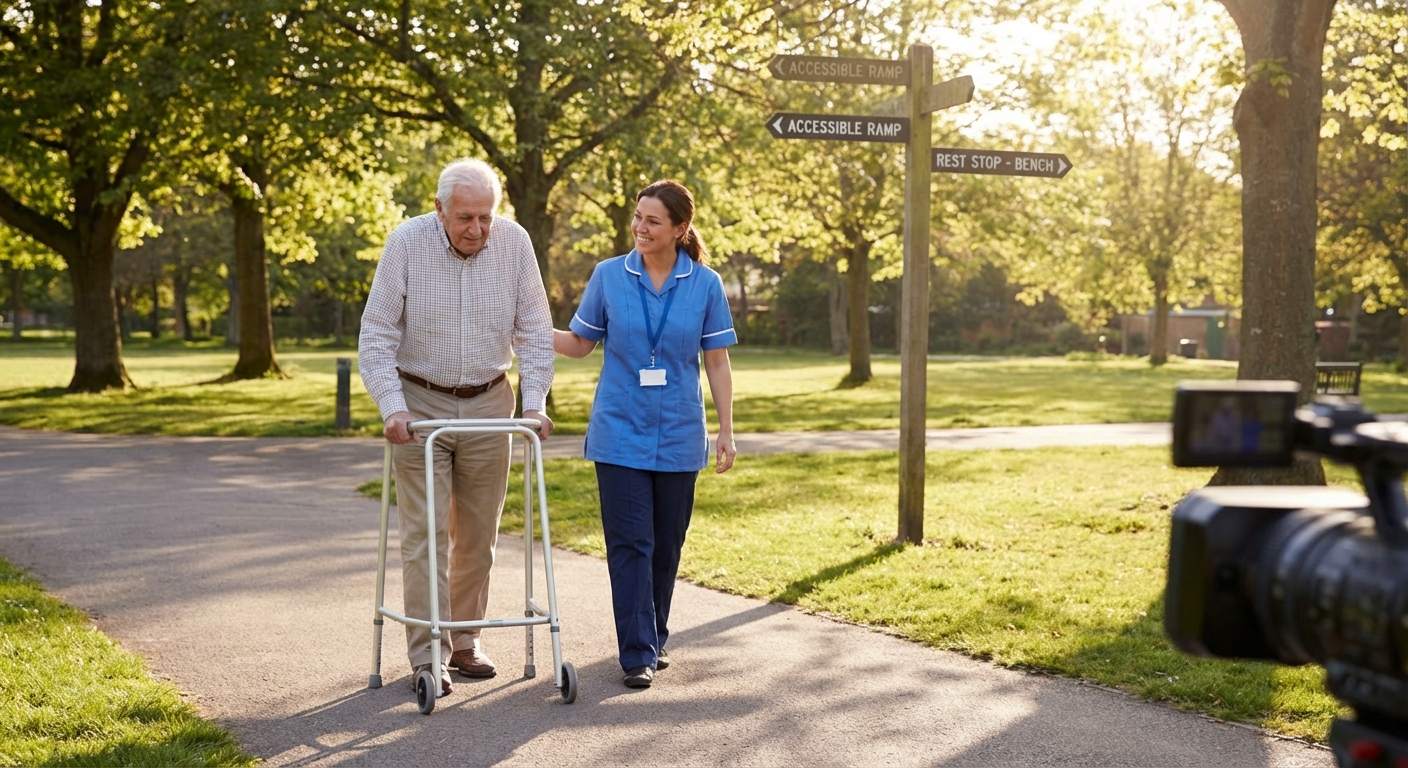
When my aunt came home after a hip replacement, her physical therapist wheeled in what looked like a small metal gate: a standard walker. She hated it—until she tried walking without it.
Standard walker vs. rollator
Standard walker (no wheels or just front wheels):- You lift or slide it forward, step into it, repeat.
- Fantastic for maximum stability and when weight-bearing is restricted.
- Terrible for longer distances or people with weak arms.
- Has hand brakes, often a storage bag, and a padded seat.
- Designed for people who need light to moderate support and like taking rest breaks.
- My dad loves his because he can stop in the grocery store aisle and sit when his back acts up.
What therapists told me
An occupational therapist I spoke with was adamant: rollators are not for everyone. If someone can’t safely use the brakes, or keeps leaning too far forward, a rollator can actually increase fall risk.
Pros
- Big stability upgrade vs. just a cane.
- Rollator = built-in seat and storage (great for shopping or walks).
- Can be adjusted in height and often fold for transport.
Cons
- Bulky in small apartments or cluttered homes.
- Rollators can “run away” on slopes if the user doesn’t properly brake.
- Some people get lazy and lean heavily on them, which messes with posture and core strength long term.
When I tested my aunt’s rollator on a downhill sidewalk, I understood the concern—if my grip had been weaker, that thing would’ve taken me for a ride.
Wheelchairs and Transport Chairs: When Walking Isn’t the Main Goal
A wheelchair isn’t always a permanent sentence. My neighbor used one for three months after a severe fall, then transitioned to a rollator. Her biggest regret was waiting too long to accept it.
Manual wheelchair vs. transport chair
- Manual wheelchair – Larger rear wheels with hand rims. The user can propel themselves. Heavier but more independent.
- Transport chair – Smaller wheels, very light, but requires another person to push. Excellent for medical appointments.
Power wheelchairs and scooters
When I tested a mobility scooter at a medical supply store (yes, the staff let me try), I finally understood why people grin riding those.
- Power wheelchairs – Joystick controlled, built for everyday, full-time use.
- Mobility scooters – Good for longer-distance trips (malls, parks), but you usually need more trunk control and arm strength.
What research says
A 2015 review in Disability and Rehabilitation: Assistive Technology found that properly prescribed wheelchairs significantly increase community participation and quality of life for older adults, especially when training and home modifications go hand in hand.
Pros
- Enable outings and activities that would otherwise be impossible.
- Reduce fall risk when walking is extremely unsafe or exhausting.
Cons
- Risk of deconditioning if they replace all walking instead of just the unsafe parts.
- Need space at home, ramp access, and sometimes vehicle modifications.
- Can be expensive; insurance coverage varies.
I’ve seen the best results when a physical therapist helps decide when to walk and when to ride, rather than choosing one or the other out of fear.
Stairlifts, Ramps, and Home Mods That Quietly Do the Heavy Lifting
Back to that staircase that almost took my dad out.
After his fall, we brought in an occupational therapist for a home safety evaluation. She walked through the house with a checklist and a brutally honest eye. Her verdict: “Either we adapt this house, or this house pushes him out.”
Stairlifts
We eventually installed a straight stairlift on the main staircase.
What I noticed when we tested it:
- It moved slower than I expected—which is good.
- The seat belt felt more reassuring than silly.
- It gave him back access to the second-floor bedroom he loved.
Research in home safety consistently shows that limiting stairs or making them safer reduces falls. A 2019 review in Age and Ageing highlighted multi-component home modification (grab bars, railings, lighting, etc.) as one of the most effective fall-prevention strategies.
Ramps
If there are steps into the home, ramps can be a game changer for walkers and wheelchairs.
From an accessibility specialist I spoke to, I learned there’s actually a recommended slope: about 1:12 (1 inch of rise for every 12 inches of ramp). Anything steeper quickly becomes unsafe.
Other quiet heroes
- Grab bars in bathrooms (not towel racks, which rip right out of the wall—I saw one fail in my aunt’s house).
- Raised toilet seats so standing up doesn’t feel like a deadlift.
- Non-slip flooring and mats in high-risk areas.
These aren’t flashy, but collectively they’re often more impactful than buying the fanciest walker.
Techy Add-Ons: Smart Canes, Fall Detectors, and GPS
I used to roll my eyes at “smart” everything, but some of the newer tech is genuinely useful.
Fall-detection wearables
Devices like the Apple Watch and certain medical alert pendants can automatically detect a hard fall and call emergency services if there’s no response. A 2021 study in NPJ Digital Medicine found that wearables can improve fall detection and response times, especially for people who live alone.
My dad wears a basic pendant. He jokes that it’s his “bat-signal.” He’s never had to use it—thankfully—but he fiddles with it less now that he trusts it.
Smart canes and tracking
Some newer canes add:
- Built-in lights for nighttime.
- GPS tracking (useful for seniors with dementia who may wander).
- Step counters and posture feedback.
When I tested a lighted cane in a dim hallway, I realized how easily a small step or rug edge can disappear into shadows. The extra visibility felt like a subtle but real upgrade.
Are these must-haves? No. But for tech-comfortable families, they can add a layer of safety and peace of mind.
How to Choose the Right Mobility Solution (Without Losing Your Mind)
Here’s the simple framework I use now, after way too much trial and error:
- Start with a professional assessment. A physical therapist or occupational therapist can evaluate balance, strength, gait, and home layout. In my experience, their advice is 10x better than guessing in a medical supply store.
- Match the device to the worst typical scenario. Not the good days—because falls usually happen on bad or tired days.
- Test before committing. Many suppliers rent devices. We rented a rollator for a month before buying and discovered my aunt preferred a slightly wider model.
- Train, don’t just hand it over. The first time my dad got his rollator, the PT spent 20 minutes just on how to turn, brake, and sit safely.
- Reassess every 6–12 months. Needs change. A cane might be enough after surgery recovery, or someone might upgrade from walker to cane after physical therapy.
The Emotional Side No One Warns You About
Mobility aids are rarely just metal and wheels. They’re emotional.
I’ve seen:
- Pride get in the way of safety.
- Adult kids push devices too aggressively and trigger resistance.
- Seniors quietly stash their cane in the closet when company comes over.
What worked best for us was framing everything as independence-preserving, not independence-taking.
I told my dad, “I don’t care if you use a cane, a walker, or ride a golden chariot. I just want you able to get your own coffee without breaking a hip.” That landed better than nagging.
A 2016 paper in The Gerontologist noted that older adults are more likely to accept mobility aids when they’re involved in the decision, understand the benefits, and don’t feel labeled as “disabled.” That matches what I’ve seen in real families.
What Actually Works Best
From all the trial, error, and expert chats, here’s what’s consistently helped the seniors in my life the most:
- A properly fitted device (cane, walker, or wheelchair)—never just “close enough.”
- A home safety walkthrough with a professional, not guesswork.
- A mindset shift: mobility devices as tools for freedom, not symbols of decline.
Not every gadget lives up to the hype. Some are overpriced, some are impractical, and some collect dust in a corner. But when the right aid matches the right person at the right time, the effect is huge: more outings, fewer falls, and a lot less fear.
If you’re at the stage of wondering whether it’s time for a cane, walker, or more, you’re not alone. I’ve been there—awkward conversations, trial runs in medical supply aisles, slightly bruised egos and all.
And in my experience, the first step toward safer mobility isn’t buying anything. It’s admitting that staying steady on your feet is worth fighting for.
The devices? Those are just the backup dancers.