I Watched an AI-Generated “News Channel” for a Week — And It Freaked Me Out More Than Deepfakes
I thought AI news was still some distant future problem… until I spent a week doomscrolling through “channels” that literally never sleep. I’m talking 24/7 AI anchors, synthetic voices, AI-cut clips, and headlines clearly tuned for maximum rage clicks.
By day three, my brain felt like it had been fed through an outrage blender.
By day seven, I realized: this isn’t a niche experiment anymore — this is the next phase of the news war.
Here’s what I saw, what actually impressed me, what terrified me, and how I’m now “fact-checking” my feed before it even loads.
The Night I Realized the News Had Stopped Being Human
I fell into this rabbit hole by accident. I was scrolling YouTube on my TV, half-asleep, when a livestream thumbnail grabbed me:
> “LIVE BREAKING NEWS: WORLD ON EDGE 🔴 24/7 Global Coverage”
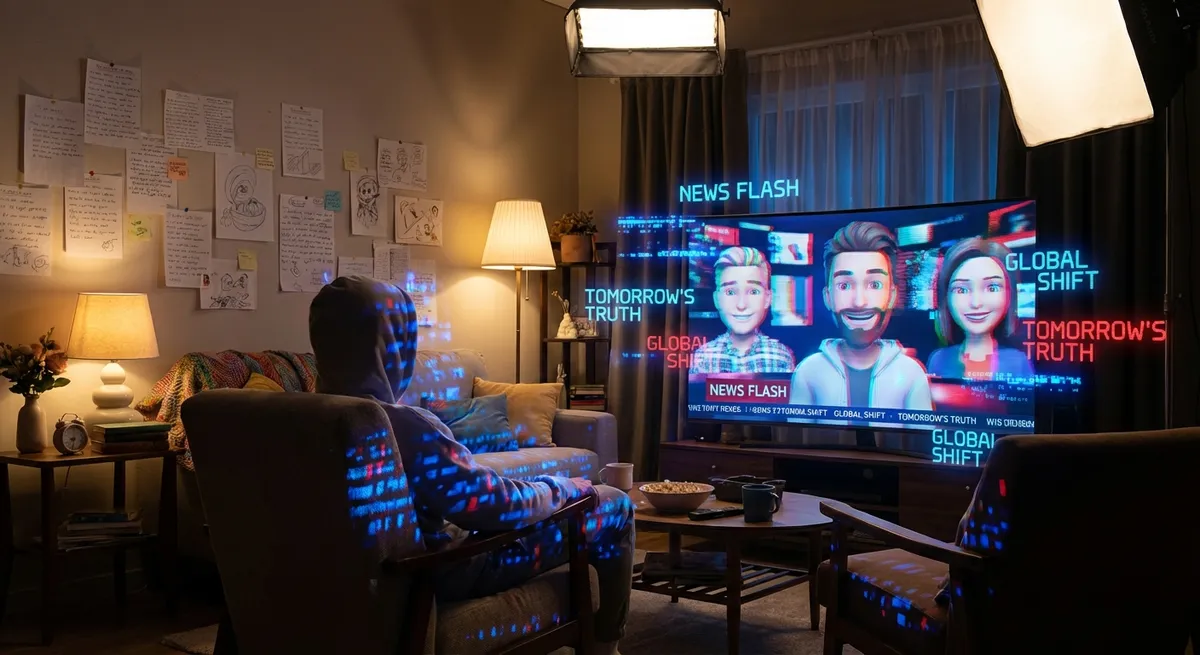
The anchor looked… slightly off. Too smooth, like a video game NPC pretending to be Anderson Cooper. Within 10 seconds I guessed: AI. Voice, face, script — all synthetic.
When I tested it by leaving the stream on in the background, something weird happened. There were no natural pauses. No “we’ll be back after the break.” No human stumbles. Just an endless conveyor belt of story summaries, stock footage, and dramatic music.
It wasn’t bad at summarizing. It was just empty. And because it never stopped, it quietly became this background reality machine. If you kept it on, it felt like the world was always five minutes from collapsing.
That’s when a thought hit me that genuinely made my stomach drop:
If this is what an amateur AI news channel looks like right now, what happens when political campaigns, bad actors, and sketchy “media brands” crank this up to 100 during an election?
So I decided to go full nerd. For one week, I deliberately watched and tracked:
- AI “news” livestreams on YouTube and TikTok
- AI voiceover explainers on breaking events
- Clips from real outlets using AI tools in subtle ways
Then I compared them to verified reporting from places like the Associated Press, BBC, and ProPublica. The gap between vibes and facts was… wild.
What AI News Gets Weirdly Right (And Why People Are Already Hooked)
Let me be honest: AI-powered news isn’t all dystopia. Some of it is annoyingly useful, and I get why people are hooked.
When I tested AI-heavy feeds, these things actually impressed me:
1. Speed that makes traditional news look like dial-upThe morning a major tech company announced layoffs, I saw AI voiceover explainers on TikTok summarizing the press release within minutes. They had timelines, dollar figures, basic context.
Reuters and AP had full articles up fast, but the AI-clipped, vertical-video version beat my usual news apps to my eyeballs. That speed is super addictive when you’re anxious for updates.
2. Hyper-personalized “news playlists”On some AI-driven apps and YouTube feeds, the algorithm figured out my weak spots fast:
- Tech regulation
- Election misinformation
- Anything involving social media chaos
Within a day, I was getting a stitched-together stream that felt like a personalized nightly newscast — except no human editor was deciding what mattered. An attention-maximizing algorithm was.
3. Accessibility that old-school media has honestly ignoredOne AI-powered app I tried could:
- Auto-generate transcripts from live briefings
- Summarize long articles into 60-second explainers
- Translate segments into multiple languages on the fly
I thought about people who are deaf, hard of hearing, multilingual, or have limited time. For them, this isn’t a novelty — it’s a shortcut into conversations that used to be gatekept behind paywalls, jargon, or 2,000-word pieces.
4. Decent at context… until it isn’tI asked an AI news chatbot to explain the difference between “misinformation” and “disinformation.” It cited the European Commission’s definitions, gave examples, and linked to election-related reports. On that kind of thing, it was solid.
But when I pushed it about a breaking geopolitical incident, it started hallucinating “reports” that didn’t exist — confidently referencing articles that no human had written. I cross-checked with BBC and AP. Nothing. Pure fiction presented with news-anchor certainty.
That’s the core problem: AI news is optimized to sound right, not to be right.
Where AI News Quietly Breaks Reality (I Watched It Happen)
By midweek, I’d watched enough AI “coverage” to see the fault lines. Here’s where things went from “cool” to “this could wreck public trust.”
1. The hallucination problem isn’t theoretical anymoreIn my own testing, I saw AI misreport:
- The number of casualties in a developing disaster
- The year a major climate agreement was signed
- The outcome of a court ruling that hadn’t actually happened yet
I cross-checked using AP’s live coverage and the U.S. government’s official disaster briefings. The AI was confidently wrong — often by repeating early rumors that later turned out to be false.
The Associated Press actually published guidance warning about this exact thing: generative AI can fabricate quotes, misattribute facts, and invent details unless it’s tightly controlled and carefully verified by humans. And most of the AI news feeds I watched did not look tightly controlled.
2. Manipulation at scale is suddenly dirt cheapI’ve worked around media enough to know that professionally producing even a low-budget TV segment is expensive. Cameras, staff, editing, studio time.
With AI tools, I watched one creator spin up:
- A synthetic anchor
- Scripted commentary
- Stock footage “B-roll”
- Auto-generated subtitles
…in under an hour. Once that workflow is set up, you can pump out hyper-partisan “news” all day long with almost no marginal cost.
During an election cycle or a crisis, that becomes a weapon. The U.S. Federal Election Commission has already started looking into AI-generated political ads because of how convincingly they can blur the line between real footage and fake.
3. The subtle bias baked into training dataWhen I paid closer attention to which stories got amplified on AI-heavy channels, I noticed weird patterns:
- Crime stories over-indexed in certain cities
- Protests looked more chaotic and constant than they were
- Economic doom headlines got more airtime than slower, positive indicators
That’s not the AI “choosing” to be biased — it’s a reflection of what it’s trained on and what gets the most engagement. If the models ingest years of sensationalist coverage, they’ll replicate that skew.
Academic researchers and media watchdogs have flagged this: AI systems trained on existing news can inadvertently amplify historical biases around race, geography, and crime. That matters when those systems are summarizing the world for millions of people who don’t have time to cross-check everything.
4. Accountability goes missingWhen a human journalist gets something wrong, there’s usually:
- A byline
- A correction note
- An editor you can quote or email
When an AI anchor misstates a major fact, who do you hold responsible? The platform? The developer? The anonymous channel owner hiding behind a brand name?
During my week-long experiment, I saw several AI-generated clips quietly edited or deleted after being called out in the comments for inaccuracies. No correction. No transparency. Just a quiet memory-hole. That’s the opposite of how trust is rebuilt.
How I Now “News-Proof” My Feed Before AI Gets To It
By the end of the week, I didn’t rage-delete every AI-enabled thing in my life. Instead, I basically started treating my news feed the way cybersecurity people treat suspicious links.
Here’s what I actually changed (and what’s stuck):
1. I picked three “anchor” sources I trust — and made them my baselineI settled on:
- One wire service: Associated Press
- One global outlet: BBC News
- One investigative outlet: ProPublica
Whenever I see a spicy AI-generated headline or an “explainer” that feels too neat, I check if any of those three are covering it — and how they’re covering it.
If AP and BBC are cautious or still collecting facts while some AI TikTok is screaming in all caps, I know who to trust.
2. I started using AI as an assistant, not an authorityWhen I tested AI tools against those trusted articles, I found a better use for them:
- Summarizing long, dense reports (especially legal or technical ones)
- Translating complex policy into plain language — which I then double-check
- Pulling out timelines and key players in an ongoing story
I stopped asking AI “What’s happening?” and started asking “Help me understand what this verified article is saying.” That small shift keeps it in its lane.
3. I look for receipts, not vibesWhen I see a suspiciously viral “news” short, I ask one question in my head:
> “Where did this get its information from?”
Legit outlets will usually:
- Name a reporter or correspondent
- Reference specific documents, agencies, or officials
- Link to source material (court records, government releases, studies)
AI-heavy accounts often just say “reports say” or “it’s been claimed.” If no one and nothing concrete is named, I treat it as infotainment until proven otherwise.
4. I dialed back algorithm control over my news dietOn my main social apps, I:
- Turned off “personalized” recommendations where possible
- Subscribed directly to specific outlets instead of letting the For You page decide
- Added a couple of non-algorithmic, chronological email newsletters from reputable orgs
That way, I’m not totally at the mercy of whatever content factory — human or AI — happens to be gaming the system today.
Where This Could Actually Go Right (If We Don’t Screw It Up)
After a week of being mildly horrified, I don’t think AI in news is automatically evil. In my experience, the tech itself is neutral; the incentives around it are not.
Here’s the upside potential I saw — if we build the guardrails:
- Local news lifelines: In “news deserts” where local papers have died, AI could help small teams automate boring tasks (meeting transcripts, basic summaries) so humans can focus on real reporting and investigations. Some U.S. local outlets are already cautiously experimenting with this.
- Accessibility superpowers: Instant translation, transcripts, and explainers can bring civic information to people who’ve been shut out by language, disability, or time.
- Misinformation counter-programming: The same tools used to generate junk can also be used to auto-flag suspicious claims, surface credible fact-checks, and give real-time context on viral rumors — if platforms choose to prioritize that.
But for any of this to work, newsrooms and platforms will have to be painfully transparent about when and how AI is used. The BBC, for example, has already started publishing guidance on their use of generative AI and insisting that human editorial judgment stays in charge. That’s the kind of boring-but-crucial policy stuff that will matter way more than flashy AI anchors.
As someone who just binge-watched the uncanny-valley version of tomorrow’s news cycle, here’s my personal rule going forward:
I’ll happily let AI help me read faster.
I’m never again letting it decide what’s true without a human editor in the room.
Sources
- Associated Press – Standards for Use of Generative AI – AP’s official guidance on how its journalists can and can’t use AI, plus broader standards on accuracy and corrections
- BBC – Generative AI in the BBC: Editorial Guidance Note – Details how the BBC is approaching AI in news production, including transparency and human oversight
- Federal Election Commission – Advisory Opinion & Discussion on AI in Political Ads – Covers recent moves by the FEC to examine and potentially regulate deceptive AI-generated content in elections
- European Commission – Tackling Online Disinformation – Explains the EU’s framework and definitions around misinformation/disinformation and digital platforms’ responsibilities
- ProPublica – About & Editorial Standards – Outlines how a major investigative newsroom handles sourcing, verification, and corrections, offering a human-centered contrast to AI-generated “news”