
I Switched My Home Internet to 5G Wireless — Here’s the Unexpected Truth
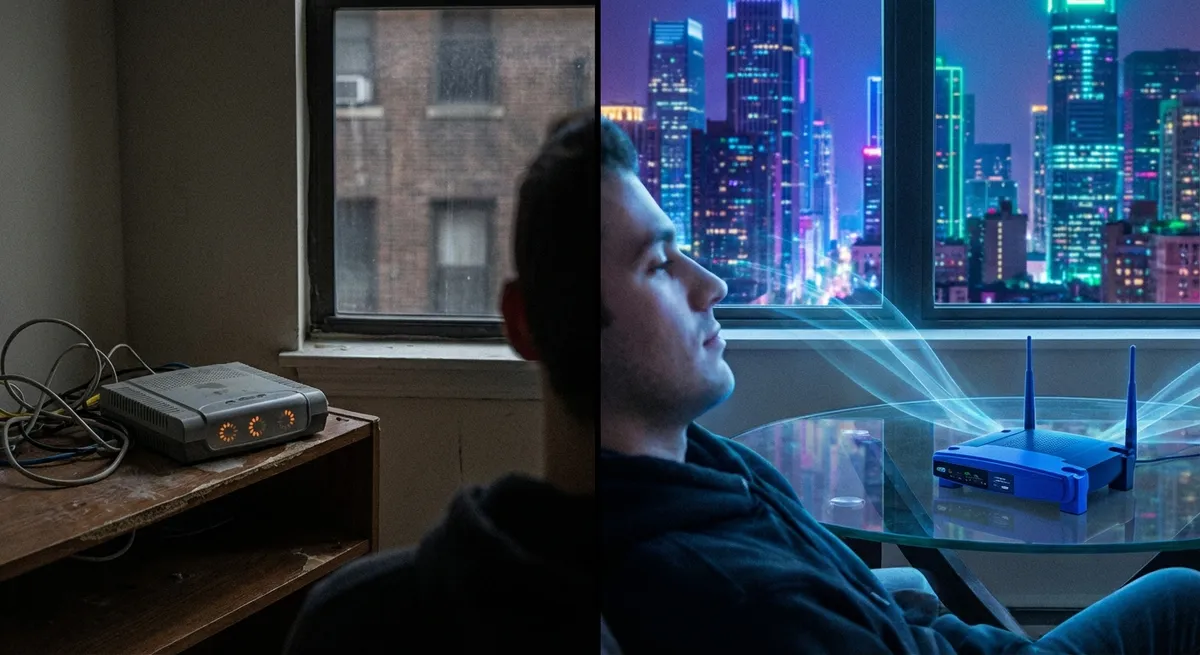
I’d been loyal to cable internet for a decade, mostly because I was too scared to touch anything that might break my endless Netflix scroll. Then my provider tried to sneak a “network enhancement fee” onto my bill and I snapped. Within a week, I’d canceled my cable plan and switched my entire apartment over to 5G home internet.
What I expected: chaos, buffering, regret.
What I got: a weird mix of “wow, this is shockingly good” and “okay, so that’s the catch.” If you’ve been watching those “cut the cord with 5G!” ads and wondering if it’s hype or actually usable, here’s the real story from someone who’s now living on a 5G-only connection.
Why I Broke Up With My Old Internet (And What 5G Promised Me)
My relationship with my cable ISP looked like this: promo price for 12 months, mysterious bill creep for 12 more, then a dreaded “renegotiation” call where I had to threaten to leave just to get back to normal-ish pricing. Rinse, repeat.
The final straw was speed vs. price. I was paying for “up to 300 Mbps” and regularly getting closer to 80–100 Mbps during peak hours, with 10 Mbps upload that made Zoom calls feel like talking through a potato. When I started uploading more video content, that upload cap hurt.
Around the same time, I started seeing 5G home internet offers popping up:
- Flat-rate pricing, no annual contract
- Router included, no installation visit
- Advertised speeds from 100–300+ Mbps
- “Just plug it in and go” energy
On paper, that sounded perfect. And not just for me—5G fixed wireless access (FWA) is actually one of the fastest-growing internet options globally because it piggybacks on the same 5G cellular networks already being built for phones. Instead of running a physical cable into your home, providers beam internet over radio waves from a nearby cell tower straight to a 5G gateway in your house.
When I checked coverage maps from two big carriers, both said my building was in a “strong 5G” zone. One was offering a 30-day satisfaction guarantee. That was my safety net. I ordered it.
The Setup: Zero Tech Guy, Zero Problem (Mostly)
The box showed up two days later. Inside: a sleek 5G gateway router, a power cable, and a card that basically said, “Plug it in. You’re done.”
I was expecting a 47-step manual. Instead, the whole setup went like this:
- Plug gateway into power.
- Download provider’s app.
- Scan QR code on the device.
- Pick a Wi‑Fi name and password.
- Walk around my apartment like a dowsing rod looking for the strongest signal.
The last part was surprisingly critical. Because 5G home internet relies on wireless signals from a tower, where you place your gateway actually matters a lot more than with traditional cable. The app had a built-in signal meter showing “weak,” “good,” or “excellent” as I moved it around.
Weird discovery:
- On my TV stand (center of the apartment): “Good”
- Next to a window facing the street: “Excellent”
- Against an interior wall near the kitchen: “Weak”
Once I settled on the window spot, the app locked in service, updated the gateway firmware, and I was online in under 15 minutes. No truck rolls, no drilling, no four-hour “appointment window” where someone might show up at 10 a.m. or might show up never.
That “just plug it in” promise? That part is real.
Life on 5G: Speed Tests, Gaming, and That One Zoom Call That Died
For the first week, I behaved like a paranoid network engineer. I ran speed tests constantly. I streamed 4K video while uploading giant files. I joined back-to-back video calls just waiting for the moment everything went sideways.
Here’s what I actually got (real numbers from my first month):
- Download speeds: Generally 180–260 Mbps
- Upload speeds: 20–40 Mbps
- Latency (ping): Around 30–40 ms to nearby servers
That download speed was noticeably better than my old cable plan during peak hours, but the upload speeds were the real glow-up. Going from 10 Mbps upload to 30–40 Mbps meant I could upload large video files in minutes instead of a small eternity.
Streaming? Flawless. I ran Netflix in 4K on the living room TV, YouTube on my laptop, and Spotify on my phone at the same time, and nothing choked.
Online gaming was the test I was most nervous about. I’m not a pro gamer, but I do play online shooters where latency matters. Did I suddenly have fiber-level ping? No. But the 30–40 ms I was seeing was totally playable, and the connection felt stable, not jittery.
Still, it wasn’t all perfect:
- One random Monday morning, my connection tanked for about 15 minutes. Zoom booted me from a meeting and my speeds dropped to 5–10 Mbps before bouncing back.
- On a couple of stormy nights, speeds dipped slightly—enough that 4K downgraded to HD once or twice, but nothing broke.
This is where the big 5G catch shows up: you’re sharing that 5G capacity with everyone else near your tower. If the network is busy—commuters, events, random surges—your speed can fluctuate more than a hard-wired cable or fiber line.
So for most people, most of the time? Totally fine, and honestly impressive. But if you need rock-solid, low-latency, non-negotiable performance 24/7 (like high-stakes competitive gaming or mission-critical remote work), that variability is something to think about.
The Nerdy Bit: How 5G Home Internet Actually Works (Without Getting Boring)
If you’ve ever wondered whether 5G home internet is just “hotspot, but bigger,” the answer is: sort of, but not exactly.
Here’s the simplified version of what I learned digging into this:
- It’s fixed wireless access (FWA). Instead of your phone moving between cell towers, your gateway sits in one spot and connects to the same tower (or set of towers) consistently.
- It uses multiple 5G “flavors.”
- Low-band 5G (similar range to 4G LTE, not super fast but great coverage)
- Mid-band 5G (the sweet spot—good speed and range)
- High-band / millimeter-wave 5G (very fast, but short range and easily blocked by walls, trees, or even rain)
Most home 5G plans lean heavily on mid-band, sometimes backed up by 4G LTE if needed. That’s why your speeds can vary, but also why your connection keeps working even when conditions aren’t perfect.
Under the hood, 5G uses tech like:
- Massive MIMO antennas (lots of tiny antennas working together to boost capacity)
- Beamforming (directing the signal more precisely toward your gateway, like a spotlight instead of a floodlight)
- Network slicing (carving up the network so different services get different performance levels—think emergency services vs someone doomscrolling memes)
To be clear, not all of that is fully turned on for consumer home internet yet, but it’s where this is heading. That’s why big players are betting hard on 5G FWA as a legit competitor to cable and even fiber in some areas.
The Bill, The Fine Print, and The Stuff Ads Don’t Shout About
I switched for the tech, but I stayed for the bill. My old cable setup cost me around:
- $75/month for internet
- $14/month for “equipment rental”
- Random taxes and mystery fees
My 5G plan is a flat rate of $50/month (with a phone plan discount), router included, and so far the only extra on the bill is standard taxes. No “regional sports network” fee randomly attached to my Wi‑Fi, which was honestly my favorite part.
But there are downsides the glossy ads don’t exactly highlight:
- Data prioritization: Some 5G plans are technically “unlimited” but still have deprioritization after a certain amount of data if the network is congested. That means your speeds might temporarily slow down if the tower is slammed and you’ve burned through a lot of data that month.
- Coverage is wildly location-dependent. My experience in a mid-sized city with strong mid-band 5G will not match someone in a rural area stuck on low-band only. Two people in the same city can have totally different results based on building materials, tower distance, and even which side of the building they live on.
- Hardware lock-in: Most providers require you to use their gateway. You can usually connect your own router behind it (which I did for better Wi‑Fi), but you can’t just slap any random 5G modem on your plan.
- Port forwarding and advanced networking: If you’re running a home server or need fancy business-level networking tricks, 5G home internet can be more limiting than traditional broadband, especially when carriers use CGNAT (carrier-grade NAT).
So yeah, the billing is simpler, but the tech stack is a little more “their way or no way.”
Who 5G Home Internet Is Amazing For (And Who Should Think Twice)
After living fully on 5G for months, here’s who I’d absolutely recommend this to—and who I’d nudge toward fiber or cable instead.
In my experience, 5G home internet is a strong fit if you:
- Live in a good 5G coverage area (mid-band or better)
- Stream a lot, browse, work from home with normal video calls
- Hate surprise fees and long contracts
- Don’t want a technician visit, drilling, or waiting weeks for install
- Have been stuck with only one traditional ISP and finally want a serious alternative
It’s riskier if you:
- Are a hardcore competitive gamer who notices every millisecond of latency
- Run servers, self-hosted services, or anything requiring open ports and strict stability
- Live in a building with thick concrete walls or spotty cell service
- Need guaranteed, consistent speeds at all times with zero fluctuation (some high-end remote jobs, broadcast work, etc.)
The best advice I can give from actually doing this: treat it like a test drive, not a tattoo. Use the 30-day guarantee if your provider offers it. Run speed tests at different times. Try your normal routine—gaming, calls, streams, uploads—and be honest about what you need vs what’s “nice to have.”
For me, the trade-offs were worth it. I got faster uploads, fewer fees, zero installation drama, and the slightly chaotic fun of knowing my internet comes from the same kind of network as my phone.
Is 5G home internet perfect? No. Is it finally a real option instead of just marketing buzz? Based on my daily experience: absolutely.
Conclusion
My internet saga used to be “Which flavor of cable pain do I pick this year?” Now it’s more like “As long as that 5G tower stays happy, I’m good.” I didn’t expect to actually prefer a wireless home connection, but the combo of easy setup, faster uploads, simpler billing, and solid everyday performance won me over.
If you’re 5G‑curious, don’t just stare at the ads—check actual coverage maps, dig into the fine print on deprioritization, and grab a trial month. Worst case, you plug the old modem back in. Best case, you quietly escape the cable treadmill and never look back.
Sources
- Federal Communications Commission – Fixed Wireless Services Overview – Explains how fixed wireless and 5G home internet fit into the broader broadband ecosystem.
- GSMA – The 5G FWA Opportunity – Industry analysis of 5G fixed wireless access growth, use cases, and performance expectations.
- Pew Research Center – Internet/Broadband Fact Sheet – Data on broadband adoption, access gaps, and how Americans get online.
- Ookla Speedtest Global Index – Real-world speed data for mobile and fixed networks worldwide, useful for comparing 5G vs traditional broadband.
- Verizon 5G Home Internet – How It Works – Example of a major provider’s technical and practical explanation of 5G home internet service.