
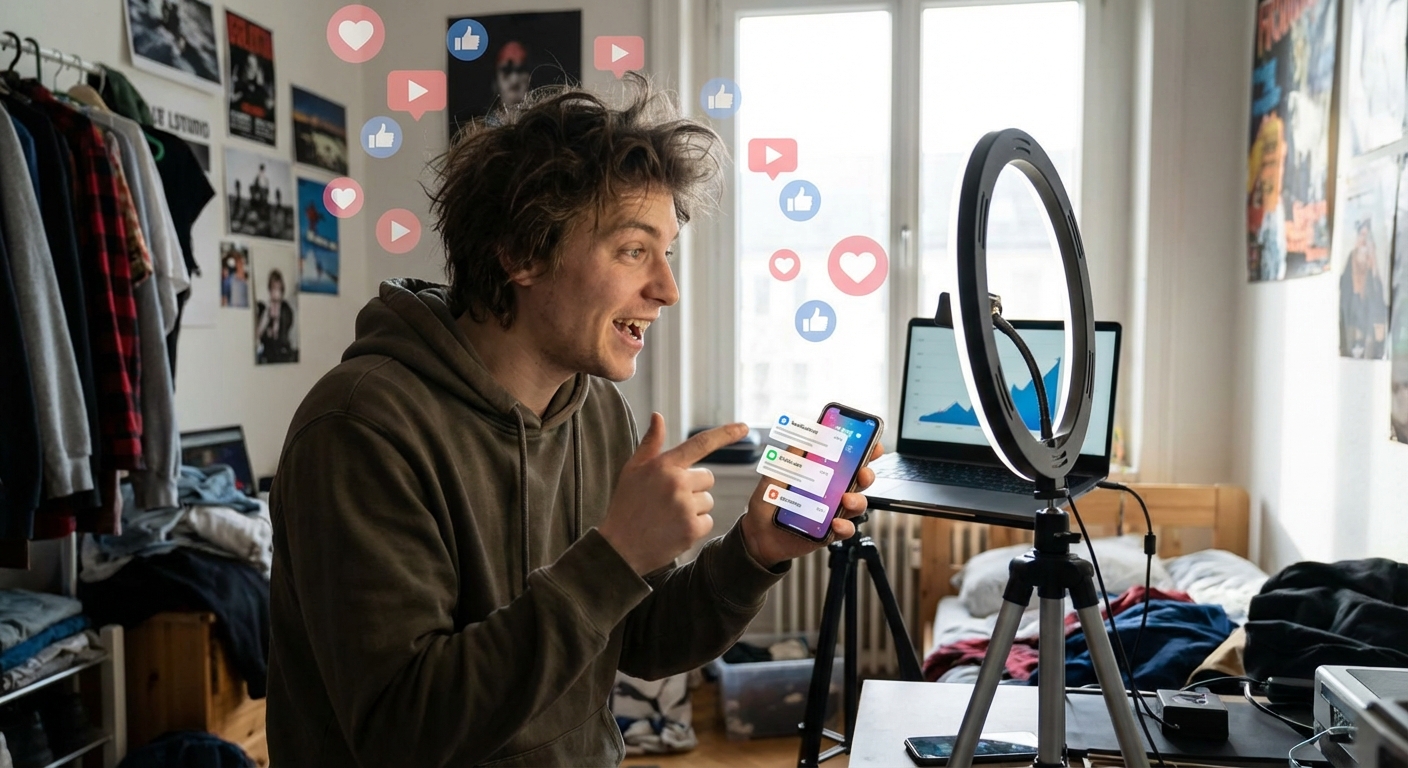
10 Ways to Go Viral
Going viral isn’t luck. It’s a repeatable mix of psychology, timing, and packaging. You can’t guarantee a billion views, but you can dramatically improve your odds.
Below are 10 powerful ways to engineer viral moments—plus 5 wild facts and stories that prove how fast the internet can explode around the right idea.
1. Trigger an Instant Emotion (Not a Mild Reaction)
Content doesn’t go viral because people like it.
It goes viral because people feel it.
High-arousal emotions drive shares:
- Awe (“How is this even real?”)
- Anger (“Everyone needs to see this”)
- Laughter (“I’m tagging my entire group chat”)
- Shock (“No way this actually happened”)
If your content can be summarized as “That was nice,” it’s already dead.
Ask:- Does this surprise me in the first 3 seconds?
- Do I feel something strong enough to interrupt my scrolling habit?
2. Make the Hook Unskippable in 3 Seconds
The first 3 seconds decide everything.
Lose them there, and the best idea in the world dies unnoticed.
Viral hooks often:
- Start mid-action: “I tried the world’s weirdest productivity hack for 7 days…”
- Create a gap: “This should not have worked—but it did.”
- Break a rule: “I applied for 50 jobs with a fake resume. Here’s what happened.”
Structure your content like this:
- Hook: Pattern break, shock, or curiosity.
- Payoff: Quickly deliver value or entertainment.
- Twist: An unexpected reveal, lesson, or emotional punch.
3. Build Content People Want to Brag About Sharing
People don’t share for you—they share for how it makes them look.
Your post is a social badge.
Ask yourself:
- Does this make someone look smart, kind, funny, or in-the-know if they share it?
- Does this let them say: “Told you so,” “This is literally us,” or “Everyone needs to see this”?
Turn your content into a bragging right:
- Threads with rare insights
- Wild but true stats
- Screenshots that prove a crazy story happened
4. Design for Screenshots and Remixes
The most viral content rarely stays in one format.
It gets:
- Screenshotted
- Stitched
- Dueted
- Turned into memes
- Reposted across platforms
Make your content modular, so people can:
- Screenshot one line and tweet it
- Use your audio for their own video
- React to your hot take in their style
If people need to ask for permission to reuse it, you’ve already slowed it down.
Pro tip: Place short, punchy one-liners in your content specifically to be screenshot and shared.5. Tell Insanely Shareable Stories (Not Just Tips)
Humans don’t remember tips.
They remember stories.
Turn your advice into narratives:
- “How I accidentally reached 3 million people by doing this wrong…”
- “The email that changed my business in 24 hours.”
- “I tried to quit my phone. The side effects were terrifying.”
Make stories:
- Personal
- Specific
- Visual
- Short enough to screenshot, deep enough to stick
A TikTok creator posted a simple video rating random couples’ outfits in New York. No sponsors. No budget. One video hit 20+ million views, brands started flying the creator out for events, and street interview content became a trend across platforms, copied thousands of times.
6. Ride Existing Waves Instead of Creating Your Own
You don’t always need to invent a new trend.
You just need to surf a big one differently.
Look for:
- Trending audios
- Challenge formats
- Viral templates ("Things I’d never do again as a…")
Then:
- Twist it to your niche
- Add a surprising angle
- Use pattern recognition: what’s blowing up right now and how can you fit inside that container?
A man skateboarding, sipping Ocean Spray cranberry juice, and lip-syncing Fleetwood Mac’s “Dreams” became a cultural moment. No complex editing, no marketing budget. The video went viral, the song re-entered the charts, and Ocean Spray famously gifted him a truck filled with juice.
7. Make It Stupidly Easy to Engage
The more friction, the fewer shares, comments, and saves.
Use:
- Low-effort prompts: “Pick one,” “Agree or disagree?”, “Yes or no?”
- Binary questions: They perform better than open-ended ones.
- Simple CTAs: “Send this to your laziest friend,” “Tag someone who would try this.”
Your goal: let people interact with your content in under two seconds.
Fact #3 (Engagement Chain Reaction): Platforms boost content that gets quick interaction. Even a small surge of comments in the first 10–30 minutes can be the difference between 1,000 and 1,000,000 views.8. Package the Same Idea in Multiple Formats
Viral ideas don’t live in one post.
They live in ecosystems.
Take one strong idea and repurpose it as:
- A 30-second TikTok
- A carousel of punchy slides
- A long-form YouTube breakdown
- A tweet thread with hooks
- A meme or reaction image
Same core message, different wrappers.
Story #3 (From Tweet to Netflix):The famous viral tweet-thread about a man’s wild road trip with a stranger (known widely as the Zola story) exploded across Twitter, then articles, then think pieces. It eventually became a feature film backed by A24. One story. Infinite formats.
9. Use Specific Numbers, Receipts, and Proof
“Trust me, this works” doesn’t go viral.
“Here’s exactly how I turned $247 into $10,493 in 21 days” might.
Specifics feel:
- More credible
- More interesting
- More shareable
Add:
- Screenshots
- Before/after images
- Exact metrics
- Concrete timelines
10. Build for Curiosity, End on a Punch
Virality = strong beginning and strong ending.
You need:
- A hook that pulls people in
- A payoff that slaps so hard they have to share
Great endings:
- Reveal an unexpected twist
- Deliver one killer line
- Flip the meaning of the whole story
Examples:
- “And that’s the moment I realized I’d built my dream life for the wrong person.”
- “The wildest part? Anyone can do this—but almost nobody will.”
- “I thought this would ruin my life. It saved it instead.”
A relatively unknown YouTuber uploaded a brutally honest video: he showed every failed project, every rejection email, and his near decision to quit. The final twist? He revealed that the video itself was his “last attempt.” It blew up—millions of views in days, sponsors arrived, and the channel became his full-time career. The ending turned a sad story into a cinematic comeback.
Final Thought: Virality Is an Engine, Not a Miracle
Going viral isn’t about begging the algorithm.
It’s about understanding people:
- What they brag about
- What they’re afraid to say out loud
- What makes them laugh, cry, rage, or gasp
Design content that:
- Hits hard emotionally
- Is easy to consume
- Is even easier to share
If you want to go viral, stop trying to be liked by everyone.
Aim to be unforgettable to someone.